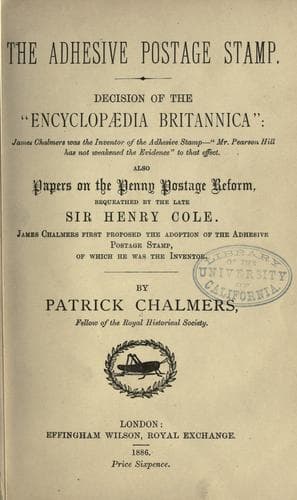
Chalmers, James, 1782-1853; Hill, Rowland, Sir, 1795-1879; Postage stamps
Hill brought the adhesive stamp under the notice
of the Commissioners of Post Office Inquiry on the 13th February, 1837.
Mr. Chalmers made no _public_ mention of his stamp of 1834 until
December, 1837."[13]
"Only a fortnight before his examination by the above-named
Commissioners Mr. Hill, in his letter to the late Lord Monteagle (then
Mr. Spring Rice, and Chancellor of the Exchequer), seems to have had no
thought of the _adhesive_ stamp. He recommends to the Treasury 'that
stamped covers and sheets of paper be supplied to the public from the
Stamp Office or Post Office ... and sold at such a price as to include
the postage.... Covers at various prices would be required for packets
of various weights. Each should have the weight it is entitled to carry
legibly printed with the stamp.... Should experience warrant the
Government in making the use of stamped covers universal,[14] most
important advantages would be secured. The Post Office would be relieved
altogether from the collection of the revenue.'[15]
"Then, upon suggestion, it would seem, of some possible difficulty that
might arise from the occasional bringing to a post-office by persons
unable to write, of unstamped letters, he added: 'Perhaps this
difficulty might be obviated by using a bit of paper just large enough
to bear the stamp, and covered at the back with a glutinous wash.' It is
a quite fair inference that this alternative had been suggested from
without.[16] In reviewing the subject, long afterwards, in his 'History
of Penny Postage,' Sir R. Hill says: 'The Post-Office opinions as to the
use of stamps for ... prepayment were on the whole favourable.'[17] In a
paper of 1839, entitled 'On the Collection of Postage by means of
Stamps,' the author continued to look upon 'stamped covers or envelopes
as the means which the public would most commonly employ; still
believing that the adhesive stamp would be reserved for exceptional
cases.'[18]
"Mulready's well-remembered allegorical cover came into use on 1st May,
1840, together with the first form of the stamped letter-paper, and the
adhesive labels. They all met at first, but only for a few days, with a
large sale. That of the first day yielded £2,500. Soon afterwards the
public rejection of the 'Mulready envelope,' writes Rowland Hill, 'was
so complete as to necessitate the destruction of nearly all the vast
number prepared for issue.' Whilst, on the other hand, the presses of
the Stamp Office were producing more than half a million of [adhesive]
labels, by working both night and day, they yet failed to meet the
demand.[19] It was only after many weeks, and after the introduction of
a series of mechanical improvements and new processes, due to the skill
and ingenuity in part of Mr. Edwin Hill of the Stamp Office, in part of
Mr. Perkins, an engraver, that the demand could be effectually
answered."
Public-domain text, read in full here on John Shaqi.
Reviews
Reviews
No reviews yet
Be the first to share your thoughts on this work.
Join the Discussion
Join the discussion
Sign in to leave a comment or review.
Sign InorCreate an account