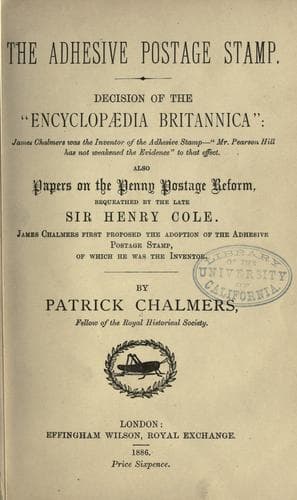
Chalmers, James, 1782-1853; Hill, Rowland, Sir, 1795-1879; Postage stamps
No wonder Sir Rowland Hill determined that no name but his own should be
heard of in connection with the adhesive stamp, for of what use is a
scheme, however desirable, if you cannot carry it out in practice? This
is what he admits on the subject soon after the simultaneous
introduction of the Mulready envelope and the adhesive stamp--"The
public rejection of the former was so complete as to necessitate the
destruction of nearly all the vast number prepared for issue." On the
other hand--"Though the presses of the Stamp Office were producing more
than half a million of adhesive stamps by working both night and day,
they yet failed to meet the demand." Up to this day, after over forty
years of public service, and notwithstanding the improvements in the
production of impressed and embossed stamps, the adhesive stamp remains
indispensable to our postal, inland revenue, telegraphic, and
parcel-post systems--"Eighteen hundred millions are issued _yearly_ from
the office of the Controller of stamps. These range in value from a
halfpenny to twenty pounds, covering postage and inland revenue from a
halfpenny to two shillings and sixpence; postage proper from five
shillings to five pounds; inland revenue proper (such as foreign bills,
sea policy stamps, &c.) from one penny to ten pounds; and fees (such as
judicature, &c.), from one penny to twenty pounds. The penny stamp takes
the first place amongst the numbers issued. Of these, as many as
thirteen hundred millions and a half were despatched from Somerset House
in the course of a recent twelvemonth."[22] Twenty-five millions of
parcels are now annually conveyed by Parcel Post, a business only
practicable through prepayment by adhesive stamp.
Thus, ever increasing in utility, thus indispensable to the carrying out
of all or any of these great public services, the value of James
Chalmers' invention and proposal--the importance of this "powerful
mechanism of the stamp"--may be best felt by the consideration that its
suspension, even for a day, would paralyse the entire commercial and
social system of the nation, it may be said "of the world" for in all
other lands, one after another, has the adhesive stamp become an
institution for similar purposes as in our own, and in corresponding
numbers.
In this sense an eminent writer has lately stated, "Whoever discovered
the adhesive stamp, the discovery has socially revolutionised the
world." "Should my plan be adopted," was the prophetic saying of Mr.
Chalmers when he sent his plan to London and to Mr. Hill himself, long
before the Penny Postage Bill was even introduced into Parliament,
"should my adhesive stamp be adopted, the demand for these will in time
become so vast, that I am only puzzled to think where premises can be
found to get them up." Surely the man who rescued the Legislature from
such a complication as has been described, surely the originator of this
indispensable and ubiquitous adhesive stamp has done the State some
service.
FOOTNOTES:
Public-domain text, read in full here on John Shaqi.
Reviews
Reviews
No reviews yet
Be the first to share your thoughts on this work.
Join the Discussion
Join the discussion
Sign in to leave a comment or review.
Sign InorCreate an account