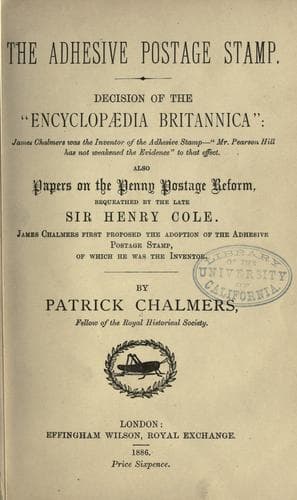
Chalmers, James, 1782-1853; Hill, Rowland, Sir, 1795-1879; Postage stamps
[22] "Chambers' Journal," March, 1885.
CONCLUSION.
Objections have been raised, both in and out of the press, to the effect
that my claim comes "too late in the day." Such objection will, I
believe, be found effectually met in my preface and former pamphlets, to
the satisfaction of any impartial mind favouring me with a perusal.
With those who decline to read my statements, amongst whom may be named
several writers of biography wrapt up in a blind worship of
pre-conceived ideas, nothing, of course, can be done.
Others say, "Get an official recognition of your claim from the Post
Office, then we will recognise you." This, again, is taking matters in
the reverse order; if the Post Office is ever to recognise me, the
pressure must come from outside, as the Post Office, under its late
chief, Mr. Shaw Lefevre, simply declines to read or cause to be read for
its information anything I may lay before it, as "not being deemed
necessary." As I have nothing to ask from that quarter, having now
gained a recognition promising to be sufficient for my purpose, I have
no present intention of again troubling the Post Office on the subject.
The feeling of _esprit de corps_, if nothing else, will probably render
the Post Office the very last body to admit that any mistake by the late
Sir Rowland Hill has been made.
But it may be said, "Did not the Post Office give Palmer, the organiser
of the mail-coach system, in addition to his pay of £3,000 a year,
£50,000?" And was not James Chalmers the successor in that line, sixty
years ago, of Palmer? Yes--but then Mr. Palmer was a man of business,
and had made his bargain with the Post Office _before_ he took the
mail-coach organisation in hand to be paid according to results; while,
after all, the £50,000 was only a compromise, obtained, moreover, only
after the repeated interference of Parliament. James Chalmers,
recognised by the leading Scottish press of the period, and by his
townsmen, never dreamt of asking a pecuniary reward. Again, was not the
Post Office in 1852 most liberal with Archer, the inventor of the
perforating machine--did they not give him £4,000 for the use of it?
Yes--but then Mr. Archer had taken out a patent for his invention, and
refused to sell the use of it for less, and it was not until after a
fruitless negotiation of five years, ending in a Parliamentary Committee
taking up the subject and insisting upon Mr. Archer being paid his
moderate demand, that the Post Office and the Treasury gave in, and but
for this Parliamentary pressure we might yet be cutting off our stamps
with a pair of scissors to this day. In the same way, then, it has been
asked, would not an infinitesimal royalty on the increasing millions of
adhesive stamps have long ago placed that originator, him and his,
amongst the wealthy of the land? Yes--but such was not the spirit in
which James Chalmers trafficked and trifled with the public interests.
Public-domain text, read in full here on John Shaqi.
Reviews
Reviews
No reviews yet
Be the first to share your thoughts on this work.
Join the Discussion
Join the discussion
Sign in to leave a comment or review.
Sign InorCreate an account