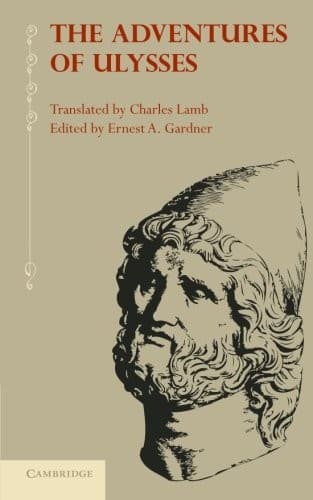
Homer. Odyssey -- Adaptations; Odysseus, King of Ithaca (Mythological character) -- Juvenile literature
The first sign of habitation which they came to was a giant's cave rudely
fashioned, but of a size which betokened the vast proportions of its
owner; the pillars which supported it being the bodies of huge oaks or
pines, in the natural state of the tree, and all about showed more marks
of strength than skill in whoever built it. Ulysses, entering it, admired
the savage contrivances and artless structure of the place, and longed to
see the tenant of so outlandish a mansion; but well conjecturing that
gifts would have more avail in extracting courtesy than strength would
succeed in forcing it, from such a one as he expected to find the
inhabitant, he resolved to flatter his hospitality with a present of Greek
wine, of which he had store in twelve great vessels, so strong that no one
ever drank it without an infusion of twenty parts of water to one of wine,
yet the fragrance of it even then so delicious that it would have vexed a
man who smelled it to abstain from tasting it; but whoever tasted it, it
was able to raise his courage to the height of heroic deeds. Taking with
them a goat-skin flagon full of this precious liquor, they ventured into
the recesses of the cave. Here they pleased themselves a whole day with
beholding the giant's kitchen, where the flesh of sheep and goats lay
strewed; his dairy, where goat-milk stood ranged in troughs and pails; his
pens, where he kept his live animals; but those he had driven forth to
pasture with him when he went out in the morning. While they were feasting
their eyes with a sight of these curiosities, their ears were suddenly
deafened with a noise like the falling of a house. It was the owner of the
cave, who had been abroad all day feeding his flock, as his custom was, in
the mountains, and now drove them home in the evening from pasture. He
threw down a pile of fire-wood, which he had been gathering against
supper-time, before the mouth of the cave, which occasioned the crash they
heard. The Grecians hid themselves in the remote parts of the cave at
sight of the uncouth monster. It was Polyphemus, the largest and savagest
of the Cyclops, who boasted himself to be the son of Neptune. He looked
more like a mountain crag than a man, and to his brutal body he had a
brutish mind answerable. He drove his flock, all that gave milk, to the
interior of the cave, but left the rams and the he-goats without. Then
taking up a stone so massy that twenty oxen could not have drawn it, he
placed it at the mouth of the cave, to defend the entrance, and sat him
down to milk his ewes and his goats; which done, he lastly kindled a fire,
and throwing his great eye round the cave (for the Cyclops have no more
than one eye, and that placed in the midst of their forehead), by the
glimmering light he discerned some of Ulysses's men.
"Ho! guests, what are you? Merchants or wandering thieves?" he bellowed
out in a voice which took from them all power of reply, it was so
astounding.
Public-domain text, read in full here on John Shaqi.
Reviews
Reviews
No reviews yet
Be the first to share your thoughts on this work.
Join the Discussion
Join the discussion
Sign in to leave a comment or review.
Sign InorCreate an account