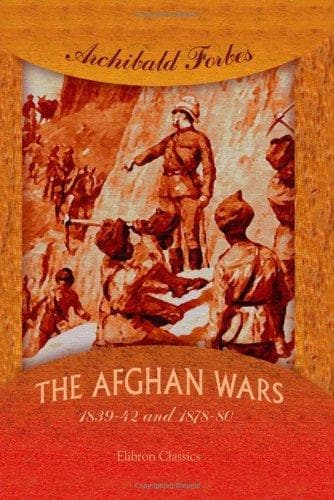
The Afghan Wars 1839-42 and 1878-80Forbes, Archibald
History
The Afghan Wars 1839-42 and 1878-80
Forbes, Archibald
Afghan Wars
A brief period of peace intervened between the ratification of the
treaty of Gundamuk on May 30th, 1879, and the renewal of hostilities
consequent on the massacre at Cabul of Sir Louis Cavagnari and the whole
_entourage_ of the mission of which he was the head. There was nothing
identical or even similar in the motives of the two campaigns, and
regarded purely on principle they might be regarded as two distinct
wars, rather than as successive campaigns of one and the same war. But
the interval between them was so short that the ink of the signatures to
the treaty of Gundamuk may be said to have been scarcely dry when the
murder of the British Envoy tore that document into bloody shreds; and
it seems the simplest and most convenient method to designate the two
years of hostilities from November 1878 to September 1880, as the
'second Afghan war,' notwithstanding the three months' interval of peace
in the summer of 1879.
Dost Mahomed died in 1863, and after a long struggle his son Shere Ali
possessed himself of the throne bequeathed to him by his father. The
relations between Shere Ali and the successive Viceroys of India were
friendly, although not close. The consistent aim of the British policy
was to maintain Afghanistan in the position of a strong, friendly, and
independent state, prepared in certain contingencies to co-operate in
keeping at a distance foreign intrigue or aggression; and while this
object was promoted by donations of money and arms, to abstain from
interference in the internal affairs of the country, while according a
friendly recognition to the successive occupants of its throne, without
undertaking indefinite liabilities in their interest. The aim, in a
word, was to utilise Afghanistan as a 'buffer' state between the
north-western frontier of British India and Russian advances from the
direction of Central Asia. Shere Ali was never a very comfortable ally;
he was of a saturnine and suspicious nature, and he seems also to have
had an overweening sense of the value of the position of Afghanistan,
interposed between two great powers profoundly jealous one of the other.
He did not succeed with Lord Northbrook in an attempt to work on that
Viceroy by playing off the bogey of Russian aggression; and as the
consequence of this failure he allowed himself to display marked
evidences of disaffected feeling. Cognisance was taken of this 'attitude
of extreme reserve,' and early in 1876 Lord Lytton arrived in India
charged with instructions to break away from the policy designated as
that of 'masterly inactivity,' and to initiate a new basis of relations
with Afghanistan and its Ameer.
Public-domain text, read in full here on John Shaqi.
Reviews
Reviews
No reviews yet
Be the first to share your thoughts on this work.
Elsewhere in the archive
Join the Discussion
Join the discussion
Sign in to leave a comment or review.
Sign InorCreate an account