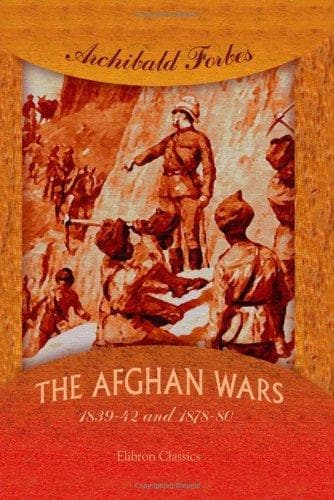
The Afghan Wars 1839-42 and 1878-80Forbes, Archibald
History
The Afghan Wars 1839-42 and 1878-80
Forbes, Archibald
Afghan Wars
The Ameer replied to the notice that a mission was about to proceed to
Cabul by a courteous declinature to receive an Envoy, assigning several
specious reasons. He was quite satisfied with the existing friendly
relations, and desired no change in them; he could not guarantee the
safety of the Envoy and his people; if he admitted a British mission, he
would have no excuse for refusing to receive a Russian one. An
intimation was conveyed to the Ameer that if he should persist in his
refusal to receive the mission, the Viceroy would have no other
alternative than to regard Afghanistan as a state which had 'voluntarily
isolated itself from the alliance and support of the British
Government.' The Ameer arranged that the Vakeel of the Indian Government
should visit Simla, carrying with him full explanations, and charged to
lay before the Viceroy sundry grievances which were distressing Shere
Ali. That functionary took back to Cabul certain minor concessions, but
conveyed the message also that those concessions were contingent on the
Ameer's acceptance of British officers about his frontiers, and that it
would be of no avail to send an Envoy to the conference at Peshawur for
which sanction was given, unless he were commissioned to agree to this
condition as the fundamental basis of a treaty. Before the Vakeel
quitted Simla he had to listen to a truculent address from Lord Lytton,
in the course of which Shere Ali's position was genially likened to that
of 'an earthen pipkin between two iron pots.' Before Sir Lewis Pelly and
the Ameer's representative met at Peshawur in January 1877, Shere Ali
had not unnaturally been perturbed by the permanent occupation of
Quetta, on the southern verge of his dominions, as indicating, along
with other military dispositions, an intended invasion. The Peshawur
conference, which from the first had little promise, dragged on
unsatisfactorily until terminated by the death of the Ameer's
representative, whereupon Sir Lewis Pelly was recalled by Lord Lytton,
notwithstanding the latter's cognisance that Shere Ali was despatching
to Peshawur a fresh Envoy authorised to assent to all the British
demands. The justification advanced by Lord Lytton for this procedure
was the discovery purported to have been made by Sir Lewis Pelly that
the Ameer was intriguing with General Kaufmann at Tashkend. Since Shere
Ali was an independent monarch, it was no crime on his part to enter
into negotiations with another power than Great Britain, although if the
worried and distracted man did so the charge of folly may be laid to
him, since the Russians were pretty certain to betray him after having
made a cat's-paw of him, and since in applying to them he involved
himself in the risk of hostile action on the part of the British. The
wisdom of Lord Lytton's conduct is not apparent. The truculent policy of
which he was the instrument was admittedly on the point of triumphing;
and events curiously falsified his short-sighted anticipation of the
Public-domain text, read in full here on John Shaqi.
Reviews
Reviews
No reviews yet
Be the first to share your thoughts on this work.
Elsewhere in the archive
Join the Discussion
Join the discussion
Sign in to leave a comment or review.
Sign InorCreate an account