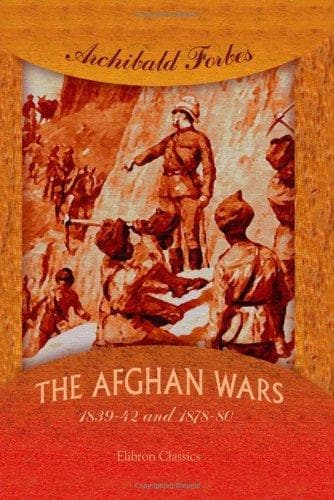
The Afghan Wars 1839-42 and 1878-80Forbes, Archibald
History
The Afghan Wars 1839-42 and 1878-80
Forbes, Archibald
Afghan Wars
of the Khyber column. The two brigades had touch of each other for the
period of an interview between the Generals, and then they fell apart
and the momentary union of communication was disrupted. General Bright
had to fall back toward Gundamuk for lack of supplies. The breach
continued open only for a few days, and then it was closed, not from
down country but from up country. Roberts, surveying the rugged country
to the east of Cabul, had discerned that the hill road toward Jugdulluk
by Luttabund, was at once opener and shorter than the customary tortuous
and overhung route through the Khoord Cabul Pass and by Tezeen. The
pioneers were set to work to improve the former. The Luttabund road
became the habitual route along which, from Cabul downwards, were posted
detachments maintaining the communications of the Cabul force with the
Khyber column and India. Nearly simultaneous with this accomplishment
was the accordance to Sir Frederick Roberts of the local rank of
Lieutenant-General, a promotion which placed him in command of all the
troops in Eastern Afghanistan down to Jumrood, and enabled him to order
up reinforcements from the Khyber column at his discretion, a power he
refrained from exercising until the moment of urgent need was impending.
After his interview at Kutti Sung with General Bright, Macpherson,
before returning to Cabul, made a short reconnaissance north of the
Cabul river toward the Lughman valley and into the Tagao country
inhabited by the fanatic tribe of the Safis. From his camp at Naghloo a
foraging party, consisting of a company of the 67th escorting a number
of camels and mules, moved westward toward a village near the junction
of the Panjshir and Cabul rivers, there to obtain supplies of grain and
forage. The little detachment on its march was suddenly met by the fire
of about 1000 Sari tribesmen. Captain Poole, observing that the
tribesmen were moving to cut him off, withdrew his party through a
defile in his rear, and taking cover under the river bank maintained a
steady fire while the camels were being retired. The Safis were
extremely bold and they too shot very straight. Captain Poole was
severely wounded and of his handful of fifty-six men eight were either
killed or wounded, but their comrades resolutely held their position
until reinforcements came out from the camp. The Safis, who retired with
dogged reluctance, were not finally routed until attacked by British
infantry in front and flank. After they broke the cavalry pursued them
for six miles, doing severe execution; the dead of the 67th were
recovered, but the poor fellows had been mutilated almost past
recognition. General Macpherson returned to Sherpur on the 20th
November, having left a strong garrison temporarily at Luttabund to
strengthen communications and open out effectually the new route
eastward.
Public-domain text, read in full here on John Shaqi.
Reviews
Reviews
No reviews yet
Be the first to share your thoughts on this work.
Elsewhere in the archive
Join the Discussion
Join the discussion
Sign in to leave a comment or review.
Sign InorCreate an account