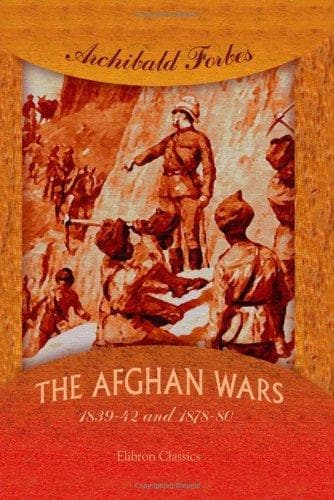
The Afghan Wars 1839-42 and 1878-80Forbes, Archibald
History
The Afghan Wars 1839-42 and 1878-80
Forbes, Archibald
Afghan Wars
When in the early spring of 1880 Sir Donald Stewart quitted Candahar
with the Bengal division of his force, he left there the Bombay
division, to the command of which General Primrose acceded, General
Phayre assuming charge of the communications. The province during the
early summer was fairly quiet, but it was known that Ayoub Khan was
making hostile preparations at Herat, although the reports as to his
intentions and movements were long uncertain and conflicting. Shere Ali
Khan, who had been Governor of Candahar during Stewart's residence
there, had been nominated hereditary ruler of the province with the
title of 'Wali,' when it was determined to separate Candahar from
North-Eastern Afghanistan. On June 21st the Wali, who had some days
earlier crossed the Helmund and occupied Girishk with his troops,
reported that Ayoub was actually on the march toward the Candahar
frontier, and asked for the support of a British brigade to enable him
to cope with the hostile advance. There was reason to believe that the
Wali's troops were disaffected, and that he was in no condition to meet
Ayoub's army with any likelihood of success. After Stewart's departure
the strength of the British forces at Candahar was dangerously low--only
4700 of all ranks; but it was important to thwart Ayoub's offensive
movement, and a brigade consisting of a troop of horse-artillery, six
companies of the 66th, two Bombay native infantry regiments, and 500
native troopers, in all about 2300 strong, under the command of
Brigadier-General Burrows, reached the left bank of the Helmund on July
11th. On the 13th the Wali's infantry, 2000 strong, mutinied _en masse_
and marched away up the right bank of the river, taking with them a
battery of smooth bore guns, a present to Shere Ali Khan from the
British Government. His cavalry did not behave quite so badly, but, not
to go into detail, his army no longer existed, and Burrows' brigade was
the only force in the field to resist the advance of Ayoub Khan, whose
regular troops were reported to number 4000 cavalry, and from 4000 to
5000 infantry exclusive of the 2000 deserters from the Wali, with thirty
guns and an irregular force of uncertain strength.
[Illustration: ACTION AT MAIWAND. 27th. July 1880.]
Public-domain text, read in full here on John Shaqi.
Reviews
Reviews
No reviews yet
Be the first to share your thoughts on this work.
Elsewhere in the archive
Join the Discussion
Join the discussion
Sign in to leave a comment or review.
Sign InorCreate an account