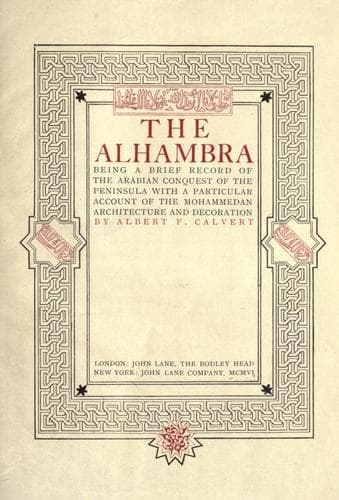
The Alhambra: being a brief record of the Arabian conquest of the Peninsula with a particular account of the Mohammedan architecture and decorationCalvert, Albert Frederick
Islamic
The Alhambra: being a brief record of the Arabian conquest of the Peninsula with a particular account of the Mohammedan architecture and decoration
LXXVI. 104 BAND AT SPRINGING OF ARCH AT THE ENTRANCE OF THE
HALL OF THE TWO SISTERS FROM THE COURT OF LIONS.
LXXVII. 105 PANELLING OF THE CENTRE RECESS, HALL OF AMBASSADORS.
LXXVIII. 106 PART OF CEILING OF THE PORTICO OF THE COURT OF THE
FISH-POND.
LXXIX. 107 BLANK WINDOW, HALL OF THE BARK.
LXXX. 108 ORNAMENTS ON THE WALLS, HOUSE OF SANCHEZ.
[Illustration: INTRODUCTION.]
“Andalus” is the name given by the Moors to that part of the Spanish
Peninsula wherein they were all-powerful for eight centuries. Andalus
comprehended the four kingdoms of Seville, Córdova, Jaen, and Granada.
(_Los Cuatro Reinos de Andalusia._)
About the year 403 of the Hegira (A.D. 1012) Granada first acquired
importance. Záwí, the African chief who then ruled in Andalusia from
Malaga to Almeria, declared himself independent, and transferred the
seat of government from Elvira[1] to Granada. Little by little the whole
population migrated to the new capital, so that Elvira dwindled to an
insignificant village, whilst Granada rose to be a magnificent city,
culminating in grandeur and importance during the reigns of three
enlightened sovereigns of the _Beni Nasr_ dynasty--Mohammed the First
(_Al-ghálib-billah_, A.D. 1232-1272), who commenced the Alhambra;[2]
Yúsuf the First (A.D. 1333), who added greatly to its beauty, and is
regarded as the monarch who completed the building; and Mohammed the
Fifth (_Al-ghaní-billah_), son of Yúsuf, who succeeded to the throne
upon the assassination of his father in 1354, and who finished the
decorations of many of the Courts and Halls of the Palace.
One of the earliest extant references to Granada is contained in the MS.
of _Ibnu Battúttah_, the Moslem traveller, who wrote in the fourteenth
century. About the year 1360 _Ibnu Battúttah_ journeyed from Morocco to
Andalus, and visited Granada, which he thus describes: “Granada is the
capital of Andalus, and the husband of its cities; its environs are a
delightful garden, covering a space of forty miles, and have not their
equal in the world. It is intersected by the well-known river
_Sheníl_[3] (Xenil) and other considerable streams, and surrounded on
every side by orchards, gardens, groves, palaces, and vineyards. One of
the most pleasant spots in its neighbourhood is that known by the name
of _’Aynu-l-adamar_--the fountain of tears--which is a spring of cold
and limpid water placed in the midst of delightful groves and gardens.”
The suburb of Granada here referred to, preserves to this day its Arabic
name corrupted into _Dinamar_, or _Adinamar_. It is a pleasant and
much-frequented spot, close to Granada.
Public-domain text, read in full here on John Shaqi.
Reviews
Reviews
No reviews yet
Be the first to share your thoughts on this work.
Join the Discussion
Join the discussion
Sign in to leave a comment or review.
Sign InorCreate an account