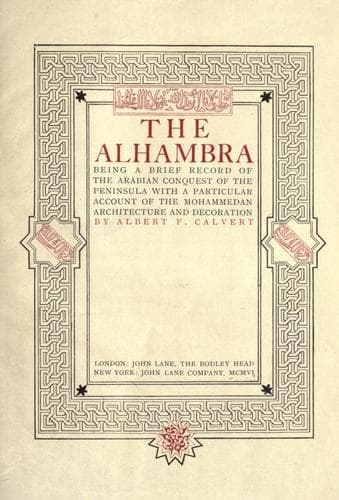
The Alhambra: being a brief record of the Arabian conquest of the Peninsula with a particular account of the Mohammedan architecture and decorationCalvert, Albert Frederick
Islamic
The Alhambra: being a brief record of the Arabian conquest of the Peninsula with a particular account of the Mohammedan architecture and decoration
The city of Granada was held in the highest estimation by Andalusian
poets. One ancient eulogist says: “If that city could reckon no other
honour but of having been the birthplace of the Wizír _Ibnu-l-khattíb_,
that alone would be sufficient. But Granada has not its like in the
world: neither Cairo, Baghdád, nor Damascus can compete with it; we can
only give an idea of its worth by comparing it to a beautiful bride, of
whose dower it should form part.”
The mention of the celebrated Wizír, _Ibnu-l-khattíb_, brings to mind a
particularly interesting figure in the history of the Alhambra, for to
him we owe the composition of many of the poems inscribed upon its
walls. He flourished A.D. 1313-1374. Amongst other works of the highest
value, of which he was the author, is a biographical dictionary of
illustrious Granadians. At an early age he attracted the notice of Yúsuf
I., who promoted him through many offices of the State, until he became
that Sultán’s Grand Wizír, in which capacity he served his master
faithfully and long. After the death of Yúsuf, he retained his high
office of Wizír under Mohammed V. for twenty years, when the hostility
of his foes brought upon him the suspicion of disloyalty. He was thrown
into prison, and strangled by order of Mohammed. “Thus,” says an
admiring biographer, “perished the phœnix of the age, the prince of
poets and historians of his time, and the model of Wizírs.”
The unfortunate _Ibnu-l-khattíb_ possessed, in the highest degree, the
faculty of improvisation. It is related that he was sent on an embassy
by Mohammed V. to implore the aid of _Fáris_, Sultán of Fez, against the
Christians. On entering the Hall of Audience, and before he delivered
his message, he uttered some verses which called forth the admiration of
all present, and were so much approved by the Sultán, that before
listening to what the Ambassador had to say on affairs of State, he
exclaimed: “By Allah! I know not the object of thy visit; but whatever
it may be, I grant the request.” In concluding the anecdote, the
narrator adds: “This circumstance elicited from the celebrated _Kádí_,
_Abú-l-kásim Ash-Sheríf_, who formed part of the embassy, the very just
remark that never until that time had there been an ambassador who
attained the object of his mission before he had made it known!”
Public-domain text, read in full here on John Shaqi.
Reviews
Reviews
No reviews yet
Be the first to share your thoughts on this work.
Join the Discussion
Join the discussion
Sign in to leave a comment or review.
Sign InorCreate an account