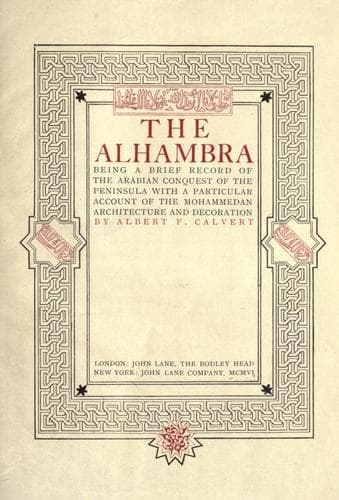
The Alhambra: being a brief record of the Arabian conquest of the Peninsula with a particular account of the Mohammedan architecture and decorationCalvert, Albert Frederick
Islamic
The Alhambra: being a brief record of the Arabian conquest of the Peninsula with a particular account of the Mohammedan architecture and decoration
It is to be lamented that an ungenerous spirit actuated the authorities
in Madrid at the time Gayángos was preparing his monumental work
(_circa_ 1840). In his own land, the assistance he had every right to
expect, was withheld! He tells us that he petitioned the Ministers of
Her Catholic Majesty for permission to visit the Library of the
Escorial, and he finds himself called upon to disclose a fact very
painful to his feelings. Don Pascual’s own words are: “Strange to say,
notwithstanding repeated applications, and the interference of persons
high in rank and influence, my request was positively denied,
professedly on the plea that the Library could not be opened, a
contention having arisen between the Government and the Royal Household
as to the possession of it!” Under the enlightened rule of King Alfonso
XIII. such treatment has become impossible: all that remains of the
literature, the splendid monuments of Arabian architecture, indeed
everything which exhibits memorials of the graceful people who have
passed away, is now open to the antiquary or the artist, and zealously
guarded with the most reverent care. No longer is there danger of wanton
spoliation of the ancient palace of the Moorish Kings of Granada. The
effort now is to retard the inevitable process of decay. The late Señor
Raphaél Contreras occupied himself for thirty-seven years in an attempt
to restore the defaced or partially-destroyed arabesques of the
Alhambra. In the course of his labour of love, it was his good fortune
to be rewarded, from time to time, by the discovery of inscriptions
which had long lain hidden; and his exertions were further recompensed
by the happiness of lighting upon and replacing parts of mutilated
ornament and portions of the edifice itself which had become dislodged
by accident or rapine, thus saving somewhat from the deluge of time.
The result of his research and discovery Don Raphaél placed before the
public in a scholarly work, entitled, _Etude Déscriptive des Monuments
Arabes_, published at Madrid, and which reached its fourth edition in
1889.
A separate, or supplementary volume was promised, which should treat of
Arabic Inscriptions remaining in Seville, Córdova, and more particularly
in Granada, belonging to the most important period of the Mohammedan
Domination in those parts of the Peninsula. It is greatly to be hoped
that the work may make its appearance under the auspices of his son, Don
Mariano Contreras, the present Conservator of the Alhambra.
That portion of the Alhambra, called the _Casa Real_, or Royal House,
appears to be but a very small part of the ancient Palace of the Moorish
Kings of Granada. It is to be regretted that no traces exist at the
present day by which its limits can be accurately defined; but we may
judge, from the gallery of
[Illustration: PANELS AND INSCRIPTIONS IN THE ALHAMBRA.]
Public-domain text, read in full here on John Shaqi.
Reviews
Reviews
No reviews yet
Be the first to share your thoughts on this work.
Join the Discussion
Join the discussion
Sign in to leave a comment or review.
Sign InorCreate an account