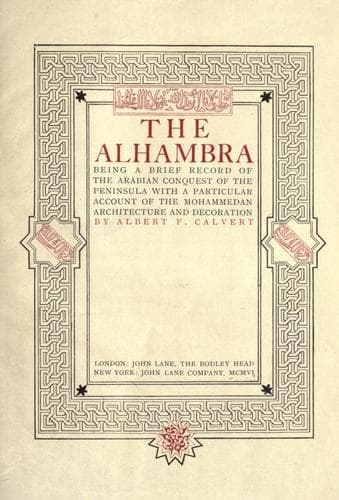
The Alhambra: being a brief record of the Arabian conquest of the Peninsula with a particular account of the Mohammedan architecture and decorationCalvert, Albert Frederick
Islamic
The Alhambra: being a brief record of the Arabian conquest of the Peninsula with a particular account of the Mohammedan architecture and decoration
two stories at the southern end of the Court of the Fish-pond, which
still remains, that the part of the Moorish building destroyed to make
way for the Palace of Charles V., must have been of considerable
consequence. No traces of the numerous apartments, which must have been
required for guards and attendants, now exist; and a most important
feature--the hareem--is wanting.
The Alhambra, occupying the plateau of the _Monte de la Assabica_, is
situated at one extremity of the city of Granada, above which it rises
like the Acropolis at Athens. The usual entrance is by the Gate of
Justice. From the Gate of Justice we pass the _Puerta del Vino_, or Wine
Gate, to the large square called the _Plaza de los Algibes_, or Place of
the Cisterns. On the right is the Palace of Charles V.; beyond, but
without revealing any indication of its internal beauty, is the
_Casa Real_; on the left of the Place of the Cisterns is the
_Alcazába_--_Kussábah_, the citadel--long used as a place of detention
for convicts. There are several ruined towers here, which are, perhaps,
the remains of the most ancient part of the fortress.
The severe and striking aspect of the towers with which the walls of the
fortress are studded, arouses no suspicion of the art and luxury
enshrined within; they are formed to impress the beholder with respect
for the power and majesty of the King; whilst within, the fragrant
shrubs and running streams, the porcelains, Mosaics, and gilded stucco
work, and particularly the pious inscriptions which are in such
profusion upon the walls, constantly reminded the sovereign how all that
ministered to his happiness was the gift of Allah.
The inscriptions are of three sorts--“_ayát_,” _i.e._, verses from the
Korán; “_asjá_,” pious or devout sentences not taken from the Korán;
and, thirdly, “_ash’ár_,” poems in praise of the builders or owners of
the Palace. Those belonging to either of the first two classes are
generally written in the Cufic character, and the letters are often so
shaped as to present a uniform appearance from both sides, and make the
inscription readable from the right to the left, and _vice versa_, or
upwards and downwards.
Public-domain text, read in full here on John Shaqi.
Reviews
Reviews
No reviews yet
Be the first to share your thoughts on this work.
Join the Discussion
Join the discussion
Sign in to leave a comment or review.
Sign InorCreate an account