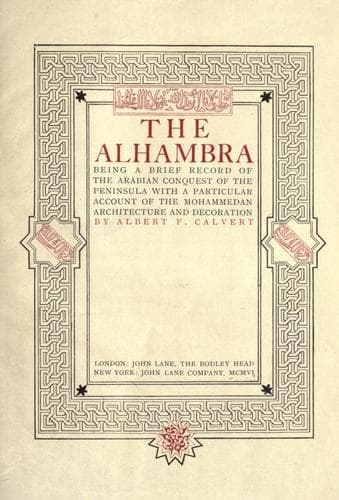
The Alhambra: being a brief record of the Arabian conquest of the Peninsula with a particular account of the Mohammedan architecture and decorationCalvert, Albert Frederick
Islamic
The Alhambra: being a brief record of the Arabian conquest of the Peninsula with a particular account of the Mohammedan architecture and decoration
Repelled within the limits of the Pyrenees, the mixed hordes of Asia and
Africa that formed this great irruption, gave up the Moslem principle of
conquest, and sought to establish in Spain a peaceable and permanent
dominion. As conquerors, their heroism was only equalled by their
moderation; and in
[Illustration: VIEW OF GRANADA, SHOWING THE ALHAMBRA AND THE SIERRA
NEVADA.]
both, for a time, they excelled the nations with whom they contended.
Severed from their native homes, they loved the land given them, as they
supposed, by Allah, and strove to adorn it with all that could minister
to the happiness of man. By a system of wise and equitable laws they
formed an empire unrivalled for its prosperity by any of the empires of
Christendom, and diligently drew around them the graces and refinements
that marked the Arabian empire in the East at the time of its
[Illustration: GENERAL VIEW OF THE ALHAMBRA FROM SAN NICOLAS.]
greatest civilisation. If the superb remains of Moslem monuments in
Spain; if the Mosque of Córdova, the Alcázar of Seville, and the
Alhambra of Granada still bear inscriptions fondly vaunting the power
and permanency of the dominion of the Moor; can the boast be derided as
arrogant and vain? They were the outposts and frontiers of Islamism. The
[Illustration: PART OF THE ALHAMBRA, EXTERIOR.]
Southern part of the Peninsula was the great battle-ground where the
Gothic conquerors of the North, and the Moslem conquerors of the East,
met and strove for mastery; the fiery courage of the Arab being at
length subdued by the obstinate and persevering valour of the
descendants of the subjects of Don Roderick. But century after century
had passed away, and still they retained a hold upon the land.[4] A
period had elapsed equal to that which has passed since England was
subjugated by the Normans; and the descendants of Musa[5] and Taric
might as little anticipate being forced into exile across the Straits
traversed by their triumphant ancestors, as the descendants of Rollo and
William may dream of being driven back to the shores of Normandy.
With all this, however, the Moslem empire in Spain was but
[Illustration: THE ALHAMBRA AND THE SIERRA NEVADA.]
a brilliant exotic that took no fixed root in the soil it adorned.
Severed from all their neighbours in the West by impassable barriers of
faith and manners, and separated by seas and deserts from their kindred
in the East, they remained an isolated people. Their whole existence was
a prolonged and gallant struggle to maintain a foothold in a land
usurped. The few relics of the miserable and proscribed race were
ultimately expelled from the Peninsula, under the administration of the
Duke of Lerma, during the reign of Philip III.--a measure which, by
depriving Spain of a numerous and industrious population, inflicted a
severe blow on her agriculture and commerce.
Public-domain text, read in full here on John Shaqi.
Reviews
Reviews
No reviews yet
Be the first to share your thoughts on this work.
Join the Discussion
Join the discussion
Sign in to leave a comment or review.
Sign InorCreate an account