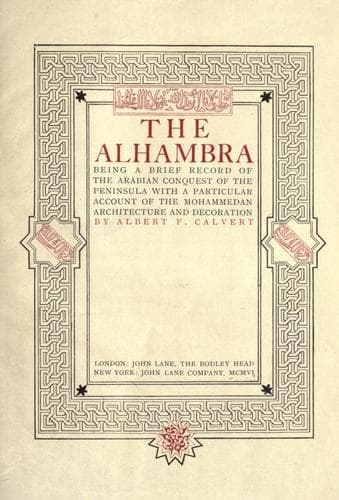
The Alhambra: being a brief record of the Arabian conquest of the Peninsula with a particular account of the Mohammedan architecture and decorationCalvert, Albert Frederick
Islamic
The Alhambra: being a brief record of the Arabian conquest of the Peninsula with a particular account of the Mohammedan architecture and decoration
Acknowledgment is made to the work of the late James Cavanah Murphy,
_Arabian Antiquities of Spain_, Lond., 1815, to which source we are
indebted for some of the illustrations to the present volume. Mr. Murphy
faithfully delineated, and admirably engraved the arabesques and mosaics
of the superb Courts and Halls of the Palace of the Alhambra at Granada.
For the rest, it may be said that a vast number of plates have been
specially prepared for the present volume; and it is thought a
confident expectation may be indulged of a favourable reception to an
attempt at preserving the reliques of a romantic pile--the glory and the
wonder of a civilised world.
“I PRAY YOU, LET US SATISFY OUR EYES
WITH THE MEMORIALS AND THE THINGS OF FAME
THAT DO RENOWN THIS CITY.”
_Twelfth Night, Act III., sc. 3._
The Alhambra.
The ancient citadel and residence of the Moorish monarchs of Granada is,
indisputably, the most curious, and in some ways the most marvellous
building that exists in the whole world. In its period, its
architectural style, and artistic effect, it is not without its
counterpart in Southern Spain; but the Alhambra was conceived and
constructed on so colossal a scale that it is accepted as the last word
in Arabian workmanship. From the outside it appears to be a forbidding
fortress, and, indeed, its walls are of prodigious strength; but within
it is a palace that was once the most voluptuous in the makings and
imaginings of man, and in which everything was made subservient to
luxury.
The singular fortunes of the Arabian, or Moresco-Spaniards, whose whole
existence is a tale that is told, certainly forms one of the most
anomalous, yet splendid episodes in history. Potent and durable as was
their dominion, we have no one distinct title by which to designate
them. They were a nation, as it were, without a legitimate country or a
name: a remote wave of the great Arabian inundation cast upon the shores
of Europe. From the year 710, when the Arab general Tarif landed at the
port which bears his name, and plundered Algeciras, to be succeeded in
the following year by a greater soldier, Geb-al-Tarik, whose name
survives in the title of “The Rock”--a familiar designation very dear to
Englishmen--the course of Moorish conquest from Gibraltar to the cliffs
of the Pyrenees was as rapid and brilliant as the ancient Moslem
victories of Syria and Egypt. Nay, had they not been checked on the
Plains of Tours by Charles _Martel_, who that day gained his
_sobriquet_--“The Hammerer”--all France, all Europe might have succumbed
to the ravages of the Saracenic warriors as completely as the empires of
the East were made to yield, and the crescent might have glittered on
the fanes of Paris and of London.
Public-domain text, read in full here on John Shaqi.
Reviews
Reviews
No reviews yet
Be the first to share your thoughts on this work.
Join the Discussion
Join the discussion
Sign in to leave a comment or review.
Sign InorCreate an account