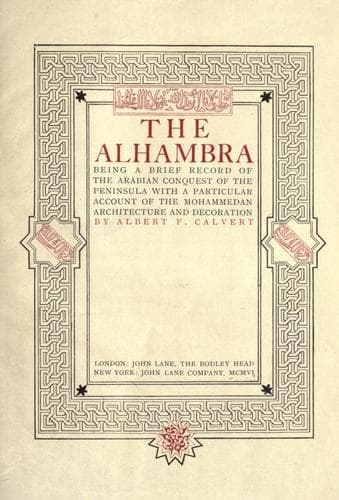
The Alhambra: being a brief record of the Arabian conquest of the Peninsula with a particular account of the Mohammedan architecture and decorationCalvert, Albert Frederick
Islamic
The Alhambra: being a brief record of the Arabian conquest of the Peninsula with a particular account of the Mohammedan architecture and decoration
It will be seen, by the style of the Gothic lettering, that the
inscription was cut in the last decade of the fifteenth century. Whether
the count of Tendilla dug the well or only constructed the cistern
remains a disputable point; it is not important; but what is by no means
clear is the strange statement that the keys were surrendered by “Muley
Hasen.” Upon the capture of Boabdil[7] at Lucena by the Count of Cabra,
he was conducted to Córdova, where he was received with much honour by
Ferdinand, after the manner, in modern times, of the reception of
Schamyl at the Court of St. Petersburg. Thereafter, Boabdil became the
instrument of the Christians, and was allowed to return to Granada,
where such confusion reigned at this time, that there were always two,
and sometimes three kings in the Moorish capital of Andalusia. The
antagonism of old Muley Hasen, his son Boabdil, and the brother of
Muley, Ez-Zaghal, “the Valiant,” all posing as kings at one time,
probably hastened the overthrow of the Moorish power.
There is much uncertainty respecting the date of Muley Hasen’s death.
Some authorities state that when he was dethroned by his son Boabdil,
“he retired to Malaga.” Others say that the king could not survive the
misfortunes that his son’s rebellion brought upon the kingdom, and
“becoming blind and mad, soon afterwards died.” One account gives his
death as occurring in September, 1484, without, however, adducing
evidence in support. Is it not just possible then, that when Malaga
fell, the old king was discovered and rode in Ferdinand’s train, to
deliver the keys of Granada, as so plainly set forth in the Gothic
inscription of the Count of Tendilla?
The circumstances which attended the growth of the Spanish nation, and
the expulsion of the Moor, were necessarily productive of an
over-zealous spirit--a spirit which is ever the inevitable consequence
of subjugation in the name of heaven, and under the immediate influence
of religious feeling. How, then, could it fail to manifest itself in the
Spaniards, who, only by a war lasting seven centuries, recovered their
own country from the hands of the Moslem--the bitterest foes of the
Christian religion--usurpers who justified their violence by retorting
the opprobrious epithet “Infidels” upon the natives? A contest, so
fierce and abiding, must have inseparably connected, in the minds of the
Spaniards, every idea of honour with orthodoxy, and all that is
discreditable and odious, with dissent from their creed. Small wonder,
then, need be expressed that the degradation of the Alhambra dates from
the very day of the Castilian Conquest, on which the removal of Moslem
symbols commenced. Have we not seen the same principles rampant in
England at the time of the Reformation, and again, throughout Puritan
times; although, in our own case, the unreasonable iconoclasts professed
the same faith?
Public-domain text, read in full here on John Shaqi.
Reviews
Reviews
No reviews yet
Be the first to share your thoughts on this work.
Join the Discussion
Join the discussion
Sign in to leave a comment or review.
Sign InorCreate an account