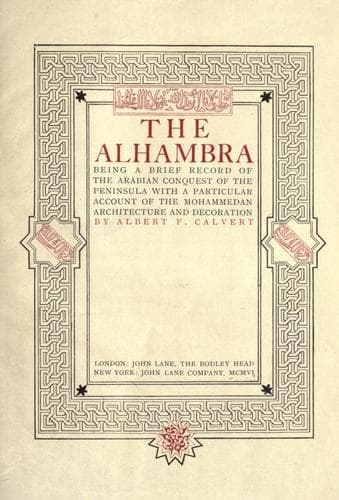
The Alhambra: being a brief record of the Arabian conquest of the Peninsula with a particular account of the Mohammedan architecture and decorationCalvert, Albert Frederick
Islamic
The Alhambra: being a brief record of the Arabian conquest of the Peninsula with a particular account of the Mohammedan architecture and decoration
The grievous vandalism begun by Ferdinand and Isabella was carried on by
their grandson, Charles V., who despoiled the palace, on an even more
gigantic scale, of those artistic glories which he looked upon as “the
ugly abominations of the Moor.” He attempted the impossible: he
modernized and rebuilt portions of the Alhambra, put up heavy ceilings,
blocked up old passages, or constructed new, and sought to convert the
palace of an Oriental sybarite into a residence for a Western monarch.
All was in vain: the last royal residents were Philip V. and his
beautiful Queen, Elizabetta of Parma, early in the eighteenth century.
Although great preparations were made for their reception, the stay of
the sovereigns was but transient; and, after their departure, the place
once more became desolate.
During the Peninsular War, when Granada was in the hands of the French,
the Alhambra was garrisoned by their troops, and the palace was
occasionally inhabited by the French commander. Washington Irving
maintains that “with that enlightened taste which has ever distinguished
the French nation--this monument of Moorish elegance and grandeur was
rescued from the absolute ruin and desolation that were overwhelming it.
The roofs were repaired, the saloons and galleries protected from the
weather, the gardens cultivated, the water-courses restored, the
fountains once more made to throw up their sparkling showers; and Spain
may thank her invaders for having preserved to her the most beautiful
and interesting of her historical monuments.... On the departure of the
French, _they blew up several towers of the outer wall, and left the
fortifications untenable_,” &c. This last act may well have been one of
military exigence; but, on the other hand, Ford entirely disagrees with
Irving, and asserts, with all the vigour of an extinct species of Tory
John Bull, that the French are responsible for the most wanton
destruction perpetrated during their occupancy. Whatever the truth may
be, we confess to a strong fellow-feeling with the kindly American
genius who has done so much to retard the decay of the edifice, which is
still preserved to adorn the land, and attract the curious of every
clime.
Public-domain text, read in full here on John Shaqi.
Reviews
Reviews
No reviews yet
Be the first to share your thoughts on this work.
Join the Discussion
Join the discussion
Sign in to leave a comment or review.
Sign InorCreate an account