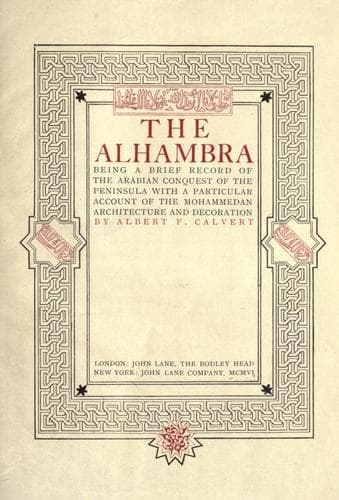
The Alhambra: being a brief record of the Arabian conquest of the Peninsula with a particular account of the Mohammedan architecture and decorationCalvert, Albert Frederick
Islamic
The Alhambra: being a brief record of the Arabian conquest of the Peninsula with a particular account of the Mohammedan architecture and decoration
The body of Yúsuf was interred in a superb sepulchre of white marble; a
long epitaph, in letters of gold upon an azure ground, recorded his
virtues: “Here lies a king and martyr, of an illustrious line, gentle,
learned and virtuous; renowned for the graces of his person and his
manners, whose clemency, piety and benevolence were extolled throughout
the kingdom of Granada. He was a great prince; an illustrious captain; a
sharp sword of the Moslems; a valiant standard-bearer amongst the most
potent monarchs.”
The Mosque, which once resounded with the dying cries of Yúsuf, still
remains, but the monument which recorded his virtues has long since
disappeared. His name, however, yet abides among the ornaments of the
Alhambra, and will be perpetuated in connection with this renowned pile,
which it was his pride and delight to adorn.
The Towers, Courts, and Halls of the Alhambra.
“As an Englishman approaches the Alhambra,” says Ford, “he rubs his
eyes, for he finds himself in a park of real English elms. Delicious
green roofs they form, but no more in keeping with the old Moorish
Palace than Bolton Abbey would be with the Pyramids. But why English?
Why; because this wood was the present of the Iron Duke, who had the
estate of Soto de Roma, with its four thousand once pheasant-haunted
acres given him reluctantly by the grateful Ferdinand VII., and who sent
out these elms from England.”
The first feeling which strikes a visitor on entering the Alhambra is
one of amazement to find himself suddenly transported to fairly-land.
Arches bearing upon pillars so slender that the wonder is they are able
to sustain the superincumbent weight--the style differing from all
regular orders of architecture--ceilings and walls incrusted with
fretwork so minute and intricate that the most patient draughtsman finds
it difficult to follow. Yet, although the patterns present so great
variety, the compotent parts are, in their origin, the same; and it is
by changing the colours and juxtaposition of the several pieces that the
astonishing diversity is produced. This exquisite Moorish work appears
to have been accomplished by means of moulds applied successively, the
continuity of the design being preserved with greatest care. Amidst or
around the complex forms are constantly disposed Arabic sentences of
moral and religious tendency, the most oft-repeated homily being, “Wa la
ghálib ila Alá,” that is, “There is no conqueror but God:” the sentence
being sometimes enclosed within Cufic characters written twice, and
forming the words signifying “Grace,” and “Blessing,” the letters so
curiously interwoven that the text may be read from left to right, and
from right to left.
PUERTA DE JUSTICIA--THE GATE OF JUSTICE.
The Gate of Justice has ever been the principal entrance into the
fortress. Like all the other towers of the Alhambra, it is built of
concrete, the jambs of the doorway being of white marble, and the
elegant horseshoe arch and spandrils of brick.
Public-domain text, read in full here on John Shaqi.
Reviews
Reviews
No reviews yet
Be the first to share your thoughts on this work.
Join the Discussion
Join the discussion
Sign in to leave a comment or review.
Sign InorCreate an account