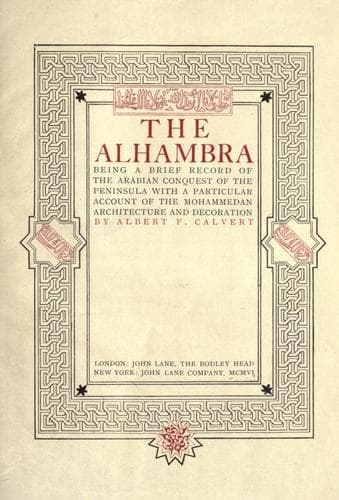
The Alhambra: being a brief record of the Arabian conquest of the Peninsula with a particular account of the Mohammedan architecture and decorationCalvert, Albert Frederick
Islamic
The Alhambra: being a brief record of the Arabian conquest of the Peninsula with a particular account of the Mohammedan architecture and decoration
took the field with great force, and laid siege to Gibraltar. Yúsuf
reluctantly took up arms, and sent troops to the relief of the place;
when, in the midst of his anxiety, he received tidings that his dreaded
foe had fallen a victim to the plague. Instead of manifesting
exultation, Yúsuf called to mind the great qualities of the deceased
monarch, and was touched with sorrow--“Alas!” cried he, “the world has
lost one of its most excellent princes; a sovereign who knew how to
honour merit, whether in friend or foe!” The Spanish chroniclers,
themselves, bear witness to this magnanimity: according to their
accounts, the Moorish cavaliers shared the sentiment of their king and
put on mourning for the death of Alonzo. Even those Moors of Gibraltar,
which had been so closely invested, when they learned that the hostile
monarch lay dead in his camp, determined that no aggressive movement
should be made against the Christians during the observance of his
obsequies.
[Illustration: THE SULTAN’S BATH, CONSTRUCTED BY YÚSUF I.]
Upon the day on which the camp was broken up, and the army departed
bearing the corpse of Alonzo, the Moors issued in multitudes from
Gibraltar, and stood mute and melancholy, watching the mournful pageant.
The same reverence for the deceased was observed on the frontiers by all
the Moorish commanders, who suffered the funeral cortège to pass in
safety with the body of the Christian sovereign, from Gibraltar to
Seville.
Yúsuf did not long survive the enemy he had so generously deplored. In
the year 1354, as he was one day at prayer in the royal Mosque of the
Alhambra, a maniac suddenly rushed upon him and plunged a dagger in his
side. The cries of the king brought his guards to his assistance: they
found him in convulsions, weltering in his blood. He was borne to the
royal apartments, and expired almost immediately. The assassin
[Illustration: COURT OF MYRTLES, OR THE FISH-POND, FORMED BY YÚSUF I.]
was cut to pieces, and his limbs burnt in public, to gratify the fury of
the populace.
The assassination of Yúsuf is described by an eye-witness in a letter
addressed to Fárris, Sultán of Western Africa, which is printed by
Pascual de Gayangos from the chronicle of Al-Makkarí--an elegant Moorish
writer who flourished towards the end of the sixteenth century:--“As
Abu-el-hejaj (Yúsuf) was performing the last prostration of his prayer,
a madman rushed upon him and wounded him with a _khanjar_, or yataghán.
The assassin was immediately secured. The Sultán, who had been mortally
wounded, made some signs as if he wished to speak;
[Illustration: THE KORAN RECESS IN THE MOSQUE, THE SCENE OF YÚSUF’S
ASSASSINATION.]
but, after uttering some unintelligible words, he was carried senseless
to his apartments, where he shortly died. The assassin, meantime, was
given up to the infuriated mob, who slew him and burned his body. The
Sultán was interred within the Alhambra. He left three sons: Mohammed,
who succeeded him; Isma’íl, and Kays.”
Public-domain text, read in full here on John Shaqi.
Reviews
Reviews
No reviews yet
Be the first to share your thoughts on this work.
Join the Discussion
Join the discussion
Sign in to leave a comment or review.
Sign InorCreate an account