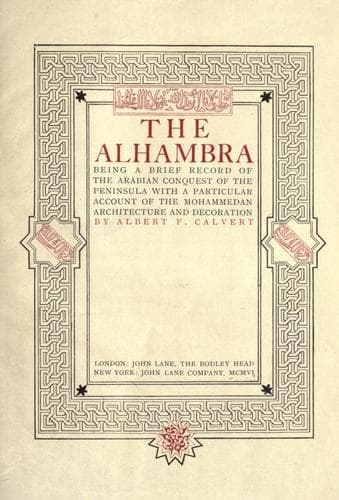
The Alhambra: being a brief record of the Arabian conquest of the Peninsula with a particular account of the Mohammedan architecture and decorationCalvert, Albert Frederick
Islamic
The Alhambra: being a brief record of the Arabian conquest of the Peninsula with a particular account of the Mohammedan architecture and decoration
[Illustration: A VIEW OF THE ROYAL VILLA OF THE GENERALIFE AT GRANADA.]
[Illustration: TRANSVERSE SECTION OF THE ROYAL VILLA OF THE GENERALIFE
AT GRANADA.]
resolution of throwing himself upon the protection of the latter, and
repairing to his Court. “He might just as well,” says the Wizír, “have
thrown himself into the jaws of a hungry tiger thirsting for blood, for
no sooner had the infidel dog cast his eyes on the countless treasures
which Mohammed and his chiefs had brought with them, than he conceived
the wicked design of murdering them and appropriating their riches; on
the second day of Rejeb, 763 (April 27, A.D. 1362) he was put to death
with all his followers, at a place called Tablada, close to Seville.”
But to return to the dethroned Sultán, Mohammed V., whose history is
highly romantic.
The people of Guadix continued their allegiance, protected his person,
and swore to devote their lives to his cause. Pedro was but lukewarm in
his behalf; and Mohammed, obtaining only vague promises from the
Christian King, crossed over to Fez at the invitation of the Sultán of
Western Africa (_Ibnu-l-Khattíb_, in his life of Mohammed V., gives the
details of
[Illustration: THE GENERALIFE.]
this journey), and made a public entrance into Fez, where he was
received with every mark of distinction.
After a long sojourn with the Sultán, Mohammed returned to Andalus in
great state with a large number of followers, his adherents greatly
increasing on his arrival at Guadix. All ranks flocked to his standard,
the presence of the long-absent and popular sovereign infusing new
vigour amongst the troops. The whole of the _Gharbia_, or Western
districts, submitted to him. He was then enabled to take Malaga and to
march upon Granada, which surrendered without opposition, and he thus
saw himself once again in possession of his dominions. His triumphant
entry into Granada took place April 6th, A.D. 1362, immediately before
the death of the usurper, Mohammed VI., at the hands of King Pedro.
Mohammed V. reigned until the year 1391, when he was succeeded by his
son, Yúsuf II.
* * * * *
To reach the summer resort of the Moorish Kings from the Alhambra, the
better way is to leave the Palace by the _Torre del Picos_--Tower of the
Peaks, or minarets--and thus approach the tall white towers and long
arcades of the Generalife. To wander amidst its gardens and groves in
the most sultry season is to enjoy a still more breezy region than that
of the Alhambra.
The Generalife is a confluence of waters: the canal of the Darro empties
its full virgin stream, and at times boils under evergreen arches
through the Acequia Court.[14] In contemplation of its beauty, the
present is forgotten in the past; old-world echoes still reverberate
through the bemyrtled Courts, where the many flowers which enamel its
terraces and aqueducts tranquilly attest that once a garden smiled:
Public-domain text, read in full here on John Shaqi.
Reviews
Reviews
No reviews yet
Be the first to share your thoughts on this work.
Elsewhere in the archive
Join the Discussion
Join the discussion
Sign in to leave a comment or review.
Sign InorCreate an account