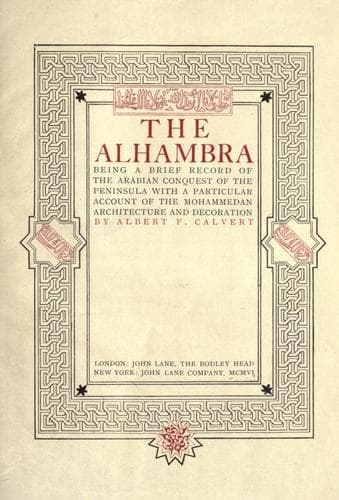
The Alhambra: being a brief record of the Arabian conquest of the Peninsula with a particular account of the Mohammedan architecture and decorationCalvert, Albert Frederick
Islamic
The Alhambra: being a brief record of the Arabian conquest of the Peninsula with a particular account of the Mohammedan architecture and decoration
“Cypress and ivy, weed and wall-flower grown
Matted and mass’d together, hillocks heap’d
On what were chambers, arch crush’d, column strown
In fragments, chok’d up vaults, and frescos steep’d
In subterranean damps, where the owl peep’d,
Deeming it midnight: Temples, baths, or halls?
Pronounce who can; for all that Learning reap’d
From her research hath been, that these are walls--”
_Childe Harold’s Pilgrimage_, Canto IV.
[Illustration: GARDEN OF THE GENERALIFE.]
[Illustration: PERSPECTIVE VIEW OF THE GARDEN OF THE GENERALIFE.]
[Illustration: ELEVATION AND GROUND PLAN OF THE PORTICO OF THE
GENERALIFE.]
What is pointed out as “the trysting place of the Sultána,” is a grove
of cypress trees, enormous in their proportions, and old as the Moors
themselves. The beautiful Zoraya, surnamed “The Morning Star,” to whom
reference has been already made, is said to have been discovered under
their spreading branches with her lover, the Abencerrage, but this is a
calumny of the _Romanceros_, and they are false witnesses. The tradition
is, but with little to substantiate it, that the Sultána was condemned
to be burnt alive, if,
[Illustration: MOSAIC, PORTICO OF THE GENERALIFE.]
within thirty days, she did not produce four knights to defend her cause
against her four accusers. The fatal day arrived; no knights appeared,
when, just at the supreme moment, there came upon the scene Don Juan de
Chacon, Lord of Carthagena (whom she had implored to become her
champion) accompanied by three other Christian knights, all in Saracenic
armour. They fought and conquered, and the last of the conspirators,
with his dying breath, confessed his invention of the false charge
against the Abencerrage and the innocent Sultána.
The reader who is desirous of perusing the circumstantial narrative of
this supposed transaction may be referred to the late Mr. Henry
Swinburne’s account in his _Travels in Spain_, while Mr. Peyron, in his
_Essays on Spain_, has given a translation of an Arabian document
purporting to be an official report concerning it.
Public-domain text, read in full here on John Shaqi.
Reviews
Reviews
No reviews yet
Be the first to share your thoughts on this work.
Elsewhere in the archive
Join the Discussion
Join the discussion
Sign in to leave a comment or review.
Sign InorCreate an account