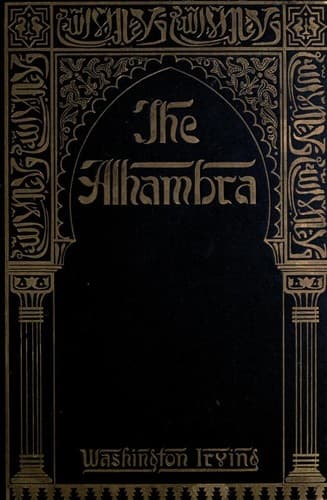
Verhalen over het gebouwencomplex in Granada, dat eigendom was van de laatste islamitische vorsten in Spanje.
The Alhambra of course, from the peculiar circumstances of its history,
is a stronghold for popular fictions of the kind; and various relics,
digged up from time to time, have contributed to strengthen them. At one
time an earthen vessel was found containing Moorish coins and the
skeleton of a cock, which, according to the opinion of certain shrewd
inspectors, must have been buried alive. At another time a vessel was
dug up containing a great scarabæus or beetle of baked clay, covered
with Arabic inscriptions, which was pronounced a prodigious amulet of
occult virtues. In this way the wits of the ragged brood who inhabit the
Alhambra have been set wool-gathering, until there is not a hall, nor
tower, nor vault, of the old fortress, that has not been made the scene
of some marvellous tradition. Having, I trust, in the preceding papers
made the reader in some degree familiar with the localities of the
Alhambra, I shall now launch out more largely into the wonderful legends
connected with it, and which I have diligently wrought into shape and
form, from various legendary scraps and hints picked up in the course of
my perambulations,--in the same manner that an antiquary works out a
regular historical document from a few scattered letters of an almost
defaced inscription.
If anything in these legends should shock the faith of the
over-scrupulous reader, he must remember the nature of the place, and
make due allowances. He must not expect here the same laws of
probability that govern commonplace scenes and every-day life; he must
remember that he treads the halls of an enchanted palace and that all is
“haunted ground.”
THE HOUSE OF THE WEATHERCOCK
On the brow of the lofty hill of the Albaycin, the highest part of
Granada, and which rises from the narrow valley of the Darro, directly
opposite to the Alhambra, stands all that is left of what was once a
royal palace of the Moors. It has, in fact, fallen into such obscurity,
that it cost me much trouble to find it, though aided in my researches
by the sagacious and all-knowing Mateo Ximenes. This edifice has borne
for centuries the name of “The House of the Weathercock” (La casa del
Gallo de Viento), from a bronze figure on one of its turrets, in ancient
times, of a warrior on horseback, and turning with every breeze. This
weathercock was considered by the Moslems of Granada a portentous
talisman. According to some traditions, it bore the following Arabic
inscription:
Calet el Bedici Aben Habuz,
Quidat ehahet Lindabuz.
Which has been rendered into Spanish:
Dice el sabio Aben Habuz,
Que asi se defiende el Anduluz.
And into English:
In this way, says Aben Habuz the Wise,
Andaluz guards against surprise.
Public-domain text, read in full here on John Shaqi.
Reviews
Reviews
No reviews yet
Be the first to share your thoughts on this work.
Elsewhere in the archive
Join the Discussion
Join the discussion
Sign in to leave a comment or review.
Sign InorCreate an account