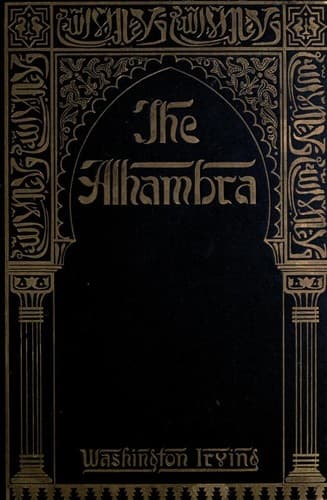
Verhalen over het gebouwencomplex in Granada, dat eigendom was van de laatste islamitische vorsten in Spanje.
This Aben Habuz, according to some of the old Moorish chronicles, was a
captain in the invading army of Taric, one of the conquerors of Spain,
who left him as Alcayde of Granada. He is supposed to have intended this
effigy as a perpetual warning to the Moslems of Andaluz, that,
surrounded by foes, their safety depended upon their being always on
their guard and ready for the field.
Others, among whom is the Christian historian Marmol, affirms “Badis
Aben Habus” to have been a Moorish sultan of Granada, and that the
weathercock was intended as a perpetual admonition of the instability of
Moslem power, bearing the following words in Arabic:
“Thus Ibn Habus al badise predicts Andalus shall one day vanish and pass
away.”[16]
Another version of this portentous inscription is given by a Moslem
historian, on the authority of Sidi Hasan, a faquir who flourished about
the time of Ferdinand and Isabella, and who was present at the taking
down of the weathercock, when the old Kassaba was undergoing repairs.
“I saw it,” says the venerable faquir, “with my own eyes; it was of a
heptagonal shape, and had the following inscription in verse:
“The palace at fair Granada presents a talisman.”
“The horseman, though a solid body, turns with every wind.”
“This to a wise man reveals a mystery. In a little while comes a
calamity to ruin both the palace and its owner.”
In effect it was not long after this meddling with the portentous
weathercock that the following event occurred. As old Muley Abul Hassan,
the king of Granada, was seated under a sumptuous pavilion, reviewing
his troops, who paraded before him in armor of polished steel and
gorgeous silken robes, mounted on fleet steeds, and equipped with
swords, spears, and shields embossed with gold and silver,--suddenly a
tempest was seen hurrying from the southwest. In a little while black
clouds overshadowed the heavens and burst forth with a deluge of rain.
Torrents came roaring down from the mountains, bringing with them rocks
and trees; the Darro overflowed its banks; mills were swept away,
bridges destroyed, gardens laid waste; the inundation rushed into the
city, undermining houses, drowning their inhabitants, and overflowing
even the square of the Great Mosque. The people rushed in affright to
the mosques to implore the mercy of Allah, regarding this uproar of the
elements as the harbinger of dreadful calamities; and, indeed, according
to the Arabian historian Al Makkari, it was but a type and prelude of
the direful war which ended in the downfall of the Moslem kingdom of
Granada.
I have thus given historic authorities sufficient to show the portentous
mysteries connected with the House of the Weathercock, and its
talismanic horseman.
I now proceed to relate still more surprising things about Aben Habuz
and his palace; for the truth of which, should any doubt be entertained,
I refer the dubious reader to Mateo Ximenes and his fellow-historiographers
of the Alhambra.
Public-domain text, read in full here on John Shaqi.
Reviews
Reviews
No reviews yet
Be the first to share your thoughts on this work.
Elsewhere in the archive
Join the Discussion
Join the discussion
Sign in to leave a comment or review.
Sign InorCreate an account