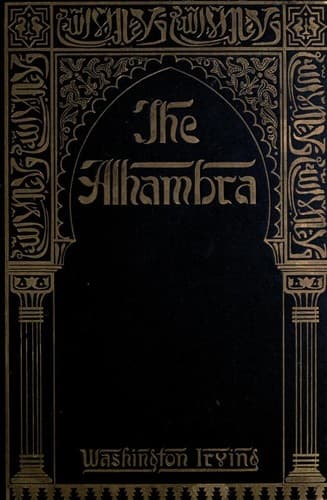
Verhalen over het gebouwencomplex in Granada, dat eigendom was van de laatste islamitische vorsten in Spanje.
Our man Sancho sought our eye, and reading permission there, gave the
old man some of the ample fragments of our repast, on condition,
however, that he should sit down and make a meal.
He accordingly took his seat at some little distance from us, and began
to eat slowly, and with a sobriety and decorum that would have become a
hidalgo. There was altogether a measured manner and a quiet
self-possession about the old man, that made me think that he had seen
better days: his language too, though simple, had occasionally something
picturesque and almost poetical in the phraseology. I set him down for
some broken-down cavalier. I was mistaken; it was nothing but the innate
courtesy of a Spaniard, and the poetical turn of thought and language
often to be found in the lowest classes of this clear-witted people. For
fifty years, he told us, he had been a shepherd, but now he was out of
employ and destitute. “When I was a young man,” said he, “nothing could
harm or trouble me; I was always well, always gay; but now I am
seventy-nine years of age, and a beggar, and my heart begins to fail
me.”
Still he was not a regular mendicant: it was not until recently that
want had driven him to this degradation; and he gave a touching picture
of the struggle between hunger and pride, when abject destitution first
came upon him. He was returning from Malaga without money; he had not
tasted food for some time, and was crossing one of the great plains of
Spain, where there were but few habitations. When almost dead with
hunger, he applied at the door of a venta or country inn. “_Perdón usted
por Dios hermano!_” (Excuse us, brother, for God’s sake!) was the
reply--the usual mode in Spain of refusing a beggar. “I turned away,”
said he, “with shame greater than my hunger, for my heart was yet too
proud. I came to a river with high banks, and deep, rapid current, and
felt tempted to throw myself in: ‘What should such an old, worthless,
wretched man as I live for?’ But when I was on the brink of the current,
I thought on the blessed Virgin, and turned away. I travelled on until I
saw a country-seat at a little distance from the road, and entered the
outer gate of the court-yard. The door was shut, but there were two
young señoras at a window. I approached and begged;--‘_Perdón usted por
Dios hermano!_’--and the window closed. I crept out of the court-yard,
but hunger overcame me, and my heart gave way: I thought my hour at
hand, so I laid myself down at the gate, commended myself to the Holy
Virgin, and covered my head to die. In a little while afterwards the
master of the house came home: seeing me lying at his gate, he uncovered
my head, had pity on my gray hairs, took me into his house, and gave me
food. So, Señors, you see that one should always put confidence in the
protection of the Virgin.”
Public-domain text, read in full here on John Shaqi.
Reviews
Reviews
No reviews yet
Be the first to share your thoughts on this work.
Join the Discussion
Join the discussion
Sign in to leave a comment or review.
Sign InorCreate an account