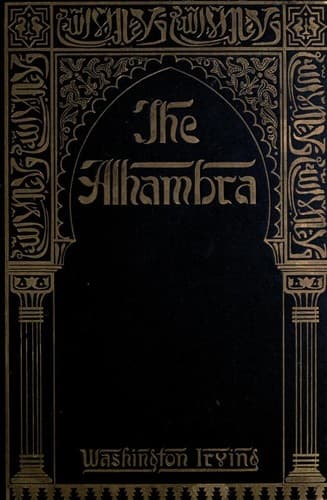
Verhalen over het gebouwencomplex in Granada, dat eigendom was van de laatste islamitische vorsten in Spanje.
Our afternoon’s ride took us through a steep and rugged defile of the
mountains, called Puerte del Rey, the Pass of the King; being one of the
great passes into the territories of Granada, and the one by which King
Ferdinand conducted his army. Towards sunset the road, winding round a
hill, brought us in sight of the famous little frontier city of Loxa,
which repulsed Ferdinand from its walls. Its Arabic name implies
guardian, and such it was to the Vega of Granada, being one of its
advanced guards. It was the stronghold of that fiery veteran, old Ali
Atar, father-in-law of Boabdil; and here it was that the latter
collected his troops, and sallied forth on that disastrous foray which
ended in the death of the old alcayde and his own captivity. From its
commanding position at the gate, as it were, of this mountain-pass, Loxa
has not unaptly been termed the key of Granada. It is wildly
picturesque; built along the face of an arid mountain. The ruins of a
Moorish alcazar or citadel crown a rocky mound which rises out of the
centre of the town. The river Xenil washes its base, winding among
rocks, and groves, and gardens, and meadows, and crossed by a Moorish
bridge. Above the city all is savage and sterile, below is the richest
vegetation and the freshest verdure. A similar contrast is presented by
the river: above the bridge it is placid and grassy, reflecting groves
and gardens; below it is rapid, noisy, and tumultuous. The Sierra
Nevada, the royal mountains of Granada, crowned with perpetual snow,
form the distant boundary to this varied landscape, one of the most
characteristic of romantic Spain.
Alighting at the entrance of the city, we gave our horses to Sancho to
lead them to the inn, while we strolled about to enjoy the singular
beauty of the environs. As we crossed the bridge to a fine alameda, or
public walk, the bells tolled the hour of orison. At the sound the
wayfarers, whether on business or pleasure, paused, took off their hats,
crossed themselves, and repeated their evening prayer: a pious custom
still rigidly observed in retired parts of Spain. Altogether it was a
solemn and beautiful evening scene, and we wandered on as the evening
gradually closed, and the new moon began to glitter between the high
elms of the alameda. We were roused from this quiet state of enjoyment
by the voice of our trusty squire hailing us from a distance. He came up
to us, out of breath. “Ah, Señores,” cried he, “el pobre Sancho no es
nada sin Don Quixote.” (Ah, Señors, poor Sancho is nothing without Don
Quixote.) He had been alarmed at our not coming to the inn; Loxa was
such a wild mountain place, full of contrabandistas, enchanters, and
infiernos; he did not well know what might have happened, and set out to
seek us, inquiring after us of every person he met, until he traced us
across the bridge, and, to his great joy, caught sight of us strolling
in the alameda.
Public-domain text, read in full here on John Shaqi.
Reviews
Reviews
No reviews yet
Be the first to share your thoughts on this work.
Join the Discussion
Join the discussion
Sign in to leave a comment or review.
Sign InorCreate an account