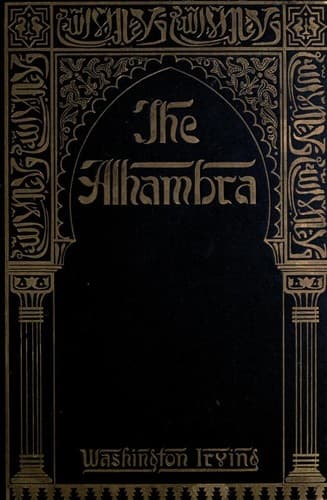
Verhalen over het gebouwencomplex in Granada, dat eigendom was van de laatste islamitische vorsten in Spanje.
The downfall of that brilliant dynasty, which had concentrated
everything at Cordova, was favorable to the general literature of
Morisco Spain.
“After the breaking of the necklace and the scattering of its pearls,”
says Ash-Shakandi, “the kings of small states divided among themselves
the patrimony of the Beni Ommiah.”
They vied with each other in filling their capitals with poets and
learned men, and rewarded them with boundless prodigality. Such were the
Moorish kings of Seville of the illustrious line of the Beni Abbad,
“with whom,” says the same writer, “resided fruit and palm-trees and
pomegranates; who became the centre of eloquence in prose and verse;
every day of whose reign was a solemn festivity; whose history abounds
in generous actions and heroic deeds, that will last through surrounding
ages and live forever in the memory of man!”
No place, however, profited more in point of civilization and refinement
by the downfall of the Western Caliphat than Granada. It succeeded to
Cordova in splendor, while it surpassed it in romantic beauty of
situation. The amenity of its climate, where the ardent heats of a
southern summer were tempered by breezes from snow-clad mountains; the
voluptuous repose of its valleys and the bosky luxuriance of its groves
and gardens all awakened sensations of delight, and disposed the mind to
love and poetry. Hence the great number of amatory poets that flourished
in Granada. Hence those amorous canticles breathing of love and war, and
wreathing chivalrous grace round the stern exercise of arms. Those
ballads which still form the pride and delight of Spanish literature are
but the echoes of amatory and chivalric lays, which once delighted the
Moslem courts of Andalus; and in which a modern historian of Granada
pretends to find the origin of the _rima Castellana_ and the type of the
“gay science” of the troubadours.[20]
Poetry was cultivated in Granada by both sexes. “Had Allah,” says
Ash-Shakandi, “bestowed no other boon on Granada than that of making it
the birthplace of so many poetesses, that alone would be sufficient for
its glory.”
Among the most famous of these was Hafsah; renowned, says the old
chronicler, for beauty, talents, nobility, and wealth. We have a mere
relic of her poetry in some verses, addressed to her lover, Ahmed,
recalling an evening passed together in the garden of Maumal.
“Allah has given us a happy night, such as he never vouchsafes to the
wicked and the ignoble. We have beheld the cypresses of Maumal gently
bowing their heads before the mountain breeze,--the sweet perfumed
breeze that smelt of gillyflowers; the dove murmured her love among the
trees; the sweet basil inclined its boughs to the limpid brook.”
Public-domain text, read in full here on John Shaqi.
Reviews
Reviews
No reviews yet
Be the first to share your thoughts on this work.
Elsewhere in the archive
Join the Discussion
Join the discussion
Sign in to leave a comment or review.
Sign InorCreate an account