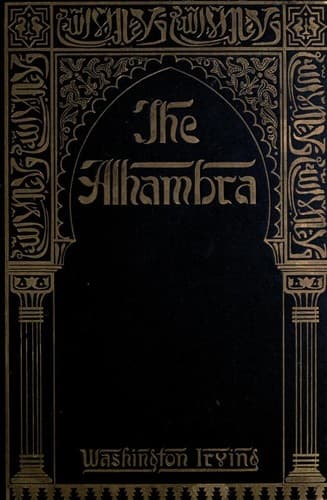
Verhalen over het gebouwencomplex in Granada, dat eigendom was van de laatste islamitische vorsten in Spanje.
Our first object of course, on the morning after our arrival, was a
visit to this time-honored edifice; it has been so often, however, and
so minutely described by travellers, that I shall not undertake to give
a comprehensive and elaborate account of it, but merely occasional
sketches of parts, with the incidents and associations connected with
them.
Leaving our posada, and traversing the renowned square of the
Vivarrambla, once the scene of Moorish jousts and tournaments, now a
crowded market-place, we proceeded along the Zacatin, the main street of
what, in the time of the Moors, was the Great Bazaar, and where small
shops and narrow alleys still retain the Oriental character. Crossing an
open place in front of the palace of the captain-general, we ascended a
confined and winding street, the name of which reminded us of the
chivalric days of Granada. It is called the Calle, or street of the
Gomeres, from a Moorish family famous in chronicle and song. This street
led up to the Puerta de las Granadas, a massive gateway of Grecian
architecture, built by Charles V., forming the entrance to the domains
of the Alhambra.
At the gate were two or three ragged superannuated soldiers, dozing on a
stone bench, the successors of the Zegris and the Abencerrages; while a
tall, meagre varlet, whose rusty-brown cloak was evidently intended to
conceal the ragged state of his nether garments, was lounging in the
sunshine and gossiping with an ancient sentinel on duty. He joined us as
we entered the gate, and offered his services to show us the fortress.
I have a traveller’s dislike to officious ciceroni, and did not
altogether like the garb of the applicant.
“You are well acquainted with the place, I presume?”
“Ninguno mas; pues, Señor, soy hijo de la Alhambra.” (Nobody better; in
fact, sir, I am a son of the Alhambra!)
The common Spaniards have certainly a most poetical way of expressing
themselves. “A son of the Alhambra!” the appellation caught me at once;
the very tattered garb of my new acquaintance assumed a dignity in my
eyes. It was emblematic of the fortunes of the place, and befitted the
progeny of a ruin.
I put some further questions to him, and found that his title was
legitimate. His family had lived in the fortress from generation to
generation ever since the time of the Conquest. His name was Mateo
Ximenes. “Then, perhaps,” said I, “you may be a descendant from the
great Cardinal Ximenes?”--“Dios Sabe! God knows, Señor! It may be so. We
are the oldest family in the Alhambra,--_Christianos Viejos_, old
Christians, without any taint of Moor or Jew. I know we belong to some
great family or other, but I forget whom. My father knows all about it:
he has the coat of arms hanging up in his cottage, up in the fortress.”
There is not any Spaniard, however poor, but has some claim to high
pedigree. The first title of this ragged worthy, however, had completely
captivated me; so I gladly accepted the services of the “son of the
Alhambra.”
Public-domain text, read in full here on John Shaqi.
Reviews
Reviews
No reviews yet
Be the first to share your thoughts on this work.
Join the Discussion
Join the discussion
Sign in to leave a comment or review.
Sign InorCreate an account