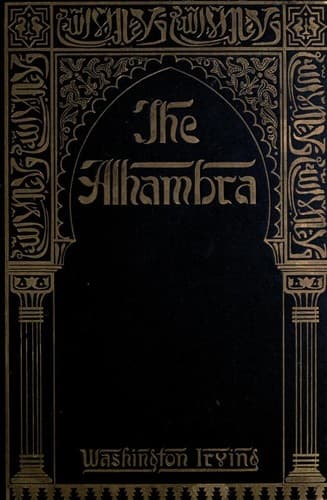
Verhalen over het gebouwencomplex in Granada, dat eigendom was van de laatste islamitische vorsten in Spanje.
We now found ourselves in a deep narrow ravine, filled with beautiful
groves, with a steep avenue, and various footpaths winding through it,
bordered with stone seats, and ornamented with fountains. To our left we
beheld the towers of the Alhambra beetling above us; to our right, on
the opposite side of the ravine, we were equally dominated by rival
towers on a rocky eminence. These, we were told, were the Torres
Vermejos, or vermilion towers, so called from their ruddy hue. No one
knows their origin. They are of a date much anterior to the Alhambra;
some suppose them to have been built by the Romans; others, by some
wandering colony of Phœnicians. Ascending the steep and shady avenue,
we arrived at the foot of a huge square Moorish tower, forming a kind of
barbican, through which passed the main entrance to the fortress. Within
the barbican was another group of veteran invalids, one mounting guard
at the portal, while the rest, wrapped in their tattered cloaks, slept
on the stone benches. This portal is called the Gate of Justice, from
the tribunal held within its porch during the Moslem domination, for the
immediate trial of petty causes: a custom common to the Oriental
nations, and occasionally alluded to in the Sacred Scriptures. “Judges
and officers shalt thou make thee _in all thy gates_, and they shall
judge the people with just judgment.”
The great vestibule, or porch of the gate, is formed by an immense
Arabian arch, of the horseshoe form, which springs to half the height of
the tower. On the keystone of this arch is engraven a gigantic hand.
Within the vestibule, on the keystone of the portal, is sculptured, in
like manner, a gigantic key. Those who pretend to some knowledge of
Mohammedan symbols, affirm that the hand is the emblem of doctrine, the
five fingers designating the five principal commandments of the creed of
Islam, fasting, pilgrimage, alms-giving, ablution, and war against
infidels. The key, say they, is the emblem of the faith or of power; the
key of Daoud, or David, transmitted to the prophet. “And the key of the
house of David will I lay upon his shoulder; so he shall open and none
shall shut, and he shall shut and none shall open.” (Isaiah xxii. 22.)
The key we are told was emblazoned on the standard of the Moslems in
opposition to the Christian emblem of the cross, when they subdued Spain
or Andalusia. It betokened the conquering power invested in the prophet.
“He that hath the key of David, he that openeth and no man shutteth;
and shutteth and no man openeth.” (Rev. iii. 7.)
Public-domain text, read in full here on John Shaqi.
Reviews
Reviews
No reviews yet
Be the first to share your thoughts on this work.
Join the Discussion
Join the discussion
Sign in to leave a comment or review.
Sign InorCreate an account