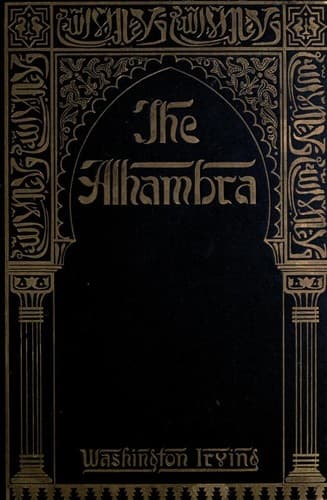
Verhalen over het gebouwencomplex in Granada, dat eigendom was van de laatste islamitische vorsten in Spanje.
A different explanation of these emblems, however, was given by the
legitimate son of the Alhambra, and one more in unison with the notions
of the common people, who attach something of mystery and magic to
everything Moorish, and have all kinds of superstitions connected with
this old Moslem fortress. According to Mateo, it was a tradition handed
down from the oldest inhabitants, and which he had from his father and
grandfather, that the hand and key were magical devices on which the
fate of the Alhambra depended. The Moorish king who built it was a great
magician, or, as some believed, had sold himself to the devil, and had
laid the whole fortress under a magic spell. By this means it had
remained standing for several years, in defiance of storms and
earthquakes, while almost all other buildings of the Moors had fallen to
ruin and disappeared. This spell, the tradition went on to say, would
last until the hand on the outer arch should reach down and grasp the
key, when the whole pile would tumble to pieces, and all the treasures
buried beneath it by the Moors would be revealed.
Notwithstanding this ominous prediction, we ventured to pass through the
spell-bound gateway, feeling some little assurance against magic art in
the protection of the Virgin, a statue of whom we observed above the
portal.
After passing through the barbican, we ascended a narrow lane, winding
between walls, and came on an open esplanade within the fortress, called
the Plaza de los Algibes, or Place of the Cisterns, from great
reservoirs which undermine it, cut in the living rock by the Moors to
receive the water brought by conduits from the Darro, for the supply of
the fortress. Here, also, is a well of immense depth, furnishing the
purest and coldest of water,--another monument of the delicate taste of
the Moors, who were indefatigable in their exertions to obtain that
element in its crystal purity.
In front of this esplanade is the splendid pile commenced by Charles V.,
and intended, it is said, to eclipse the residence of the Moorish kings.
Much of the Oriental edifice intended for the winter season was
demolished to make way for this massive pile. The grand entrance was
blocked up; so that the present entrance to the Moorish palace is
through a simple and almost humble portal in a corner. With all the
massive grandeur and architectural merit of the palace of Charles V., we
regarded it as an arrogant intruder, and passing by it with a feeling
almost of scorn, rang at the Moslem portal.
Public-domain text, read in full here on John Shaqi.
Reviews
Reviews
No reviews yet
Be the first to share your thoughts on this work.
Join the Discussion
Join the discussion
Sign in to leave a comment or review.
Sign InorCreate an account