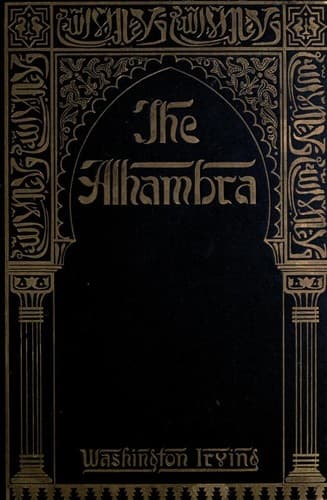
Verhalen over het gebouwencomplex in Granada, dat eigendom was van de laatste islamitische vorsten in Spanje.
Passing from the Court of the Alberca under a Moorish archway, we
entered the renowned Court of Lions. No part of the edifice gives a more
complete idea of its original beauty than this, for none has suffered so
little from the ravages of time. In the centre stands the fountain
famous in song and story. The alabaster basins still shed their diamond
drops; the twelve lions which support them, and give the court its name,
still cast forth crystal streams as in the days of Boabdil. The lions,
however, are unworthy of their fame, being of miserable sculpture, the
work probably of some Christian captive. The court is laid out in
flower-beds, instead of its ancient and appropriate pavement of tiles or
marble; the alteration, an instance of bad taste, was made by the French
when in possession of Granada. Round the four sides of the court are
light Arabian arcades of open filigree work, supported by slender
pillars of white marble, which it is supposed were originally gilded.
The architecture, like that in most parts of the interior of the palace,
is characterized by elegance rather than grandeur, bespeaking a
delicate and graceful taste, and a disposition to indolent enjoyment.
When one looks upon the fairy traces of the peristyles, and the
apparently fragile fretwork of the walls, it is difficult to believe
that so much has survived the wear and tear of centuries, the shocks of
earthquakes, the violence of war, and the quiet, though no less baneful,
pilferings of the tasteful traveller: it is almost sufficient to excuse
the popular tradition, that the whole is protected by a magic charm.
On one side of the court a rich portal opens into the Hall of the
Abencerrages: so called from the gallant cavaliers of that illustrious
line who were here perfidiously massacred. There are some who doubt the
whole story, but our humble cicerone Mateo pointed out the very wicket
of the portal through which they were introduced one by one into the
Court of Lions, and the white marble fountain in the centre of the hall
beside which they were beheaded. He showed us also certain broad ruddy
stains on the pavement, traces of their blood, which, according to
popular belief, can never be effaced.
Finding we listened to him apparently with easy faith, he added, that
there was often heard at night, in the Court of Lions, a low confused
sound, resembling the murmuring of a multitude; and now and then a faint
tinkling, like the distant clank of chains. These sounds were made by
the spirits of the murdered Abencerrages; who nightly haunt the scene of
their suffering and invoke the vengeance of Heaven on their destroyer.
The sounds in question had no doubt been produced, as I had afterwards
an opportunity of ascertaining, by the bubbling currents and tinkling
falls of water conducted under the pavement through pipes and channels
to supply the fountains; but I was too considerate to intimate such an
idea to the humble chronicler of the Alhambra.
Public-domain text, read in full here on John Shaqi.
Reviews
Reviews
No reviews yet
Be the first to share your thoughts on this work.
Join the Discussion
Join the discussion
Sign in to leave a comment or review.
Sign InorCreate an account