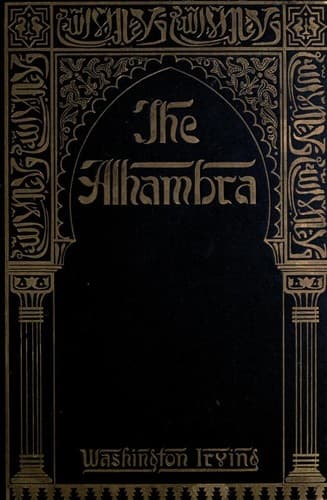
Verhalen over het gebouwencomplex in Granada, dat eigendom was van de laatste islamitische vorsten in Spanje.
Encouraged by my easy credulity, Mateo gave me the following as an
undoubted fact, which he had from his grandfather:--
There was once an invalid soldier, who had charge of the Alhambra to
show it to strangers; as he was one evening, about twilight, passing
through the Court of Lions, he heard footsteps on the Hall of the
Abencerrages; supposing some strangers to be lingering there, he
advanced to attend upon them, when to his astonishment he beheld four
Moors richly dressed, with gilded cuirasses and cimeters, and poniards
glittering with precious stones. They were walking to and fro, with
solemn pace; but paused and beckoned to him. The old soldier, however,
took to flight, and could never afterwards be prevailed upon to enter
the Alhambra. Thus it is that men sometimes turn their backs upon
fortune; for it is the firm opinion of Mateo, that the Moors intended to
reveal the place where their treasures lay buried. A successor to the
invalid soldier was more knowing; he came to the Alhambra poor; but at
the end of a year went off to Malaga, bought houses, set up a carriage,
and still lives there, one of the richest as well as oldest men of the
place; all which, Mateo sagely surmised, was in consequence of his
finding out the golden secret of these phantom Moors.
I now perceived I had made an invaluable acquaintance in this son of the
Alhambra, one who knew all the apocryphal history of the place, and
firmly believed in it, and whose memory was stuffed with a kind of
knowledge for which I have a lurking fancy, but which is too apt to be
considered rubbish by less indulgent philosophers. I determined to
cultivate the acquaintance of this learned Theban.
Immediately opposite the Hall of the Abencerrages, a portal, richly
adorned, leads into a hall of less tragical associations. It is light
and lofty, exquisitely graceful in its architecture, paved with white
marble, and bears the suggestive name of the Hall of the Two Sisters.
Some destroy the romance of the name by attributing it to two enormous
slabs of alabaster which lie side by side, and form a great part of the
pavement: an opinion strongly supported by Mateo Ximenes. Others are
disposed to give the name a more poetical significance, as the vague
memorial of Moorish beauties who once graced this hall, which was
evidently a part of the royal harem. This opinion I was happy to find
entertained by our little bright-eyed guide, Dolores, who pointed to a
balcony over an inner porch; which gallery, she had been told, belonged
to the women’s apartment. “You see, Señor,” said she, “it is all grated
and latticed, like the gallery in a convent chapel where the nuns hear
mass; for the Moorish kings,” added she, indignantly, “shut up their
wives just like nuns.”
The latticed “jalousies,” in fact, still remain, whence the dark-eyed
beauties of the harem might gaze unseen upon the zambras and other
dances and entertainments of the hall below.
Public-domain text, read in full here on John Shaqi.
Reviews
Reviews
No reviews yet
Be the first to share your thoughts on this work.
Join the Discussion
Join the discussion
Sign in to leave a comment or review.
Sign InorCreate an account