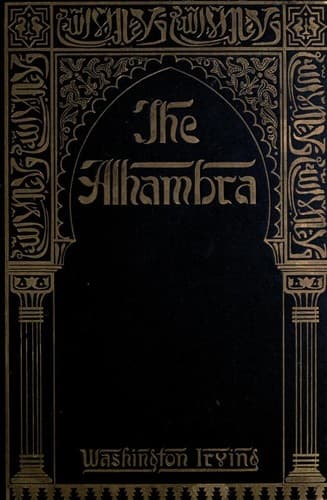
Verhalen over het gebouwencomplex in Granada, dat eigendom was van de laatste islamitische vorsten in Spanje.
There is something, too, in the sternly simple features of the Spanish
landscape, that impresses on the soul a feeling of sublimity. The
immense plains of the Castiles and of La Mancha, extending as far as the
eye can reach, derive an interest from their very nakedness and
immensity, and possess, in some degree, the solemn grandeur of the
ocean. In ranging over these boundless wastes, the eye catches sight
here and there of a straggling herd of cattle attended by a lonely
herdsman, motionless as a statue, with his long slender pike tapering up
like a lance into the air; or beholds a long train of mules slowly
moving along the waste like a train of camels in the desert; or a single
horseman, armed with blunderbuss and stiletto, and prowling over the
plain. Thus the country, the habits, the very looks of the people, have
something of the Arabian character. The general insecurity of the
country is evinced in the universal use of weapons. The herdsman in the
field, the shepherd in the plain, has his musket and his knife. The
wealthy villager rarely ventures to the market-town without his trabuco,
and, perhaps, a servant on foot with a blunderbuss on his shoulder; and
the most petty journey is undertaken with the preparation of a warlike
enterprise.
The dangers of the road produce also a mode of travelling resembling, on
a diminutive scale, the caravans of the East. The arrieros, or carriers,
congregate in convoys, and set off in large and well-armed trains on
appointed days; while additional travellers swell their number, and
contribute to their strength. In this primitive way is the commerce of
the country carried on. The muleteer is the general medium of traffic,
and the legitimate traverser of the land, crossing the peninsula from
the Pyrenees and the Asturias to the Alpuxarras, the Serrania de Ronda,
and even to the gates of Gibraltar. He lives frugally and hardily: his
alforjas of coarse cloth hold his scanty stock of provisions; a leathern
bottle, hanging at his saddle-bow, contains wine or water, for a supply
across barren mountains and thirsty plains; a mule-cloth spread upon the
ground is his bed at night, and his pack-saddle his pillow. His low, but
clean-limbed and sinewy form betokens strength; his complexion is dark
and sunburnt; his eye resolute, but quiet in its expression, except
when kindled by sudden emotion; his demeanor is frank, manly, and
courteous, and he never passes you without a grave salutation: “Dios
guarde à usted!” “Va usted con Dios, Caballero!” “God guard you!” “God
be with you, Cavalier!”
Public-domain text, read in full here on John Shaqi.
Reviews
Reviews
No reviews yet
Be the first to share your thoughts on this work.
Join the Discussion
Join the discussion
Sign in to leave a comment or review.
Sign InorCreate an account