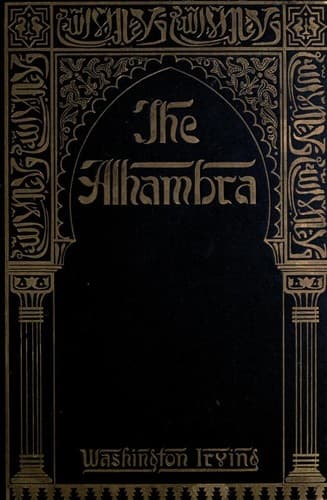
Verhalen over het gebouwencomplex in Granada, dat eigendom was van de laatste islamitische vorsten in Spanje.
As these men have often their whole fortune at stake upon the burden of
their mules, they have their weapons at hand, slung to their saddles,
and ready to be snatched out for desperate defence; but their united
numbers render them secure against petty bands of marauders, and the
solitary bandolero, armed to the teeth, and mounted on his Andalusian
steed, hovers about them, like a pirate about a merchant convoy, without
daring to assault.
The Spanish muleteer has an inexhaustible stock of songs and ballads,
with which to beguile his incessant wayfaring. The airs are rude and
simple, consisting of but few inflections. These he chants forth with a
loud voice, and long, drawling cadence, seated sideways on his mule, who
seems to listen with infinite gravity, and to keep time, with his paces,
to the tune. The couplets thus chanted are often old traditional
romances about the Moors, or some legend of a saint, or some love-ditty;
or, what is still more frequent, some ballad about a bold
contrabandista, or hardy bandolero, for the smuggler and the robber are
poetical heroes among the common people of Spain. Often, the song of the
muleteer is composed at the instant, and relates to some local scene, or
some incident of the journey. This talent of singing and improvising is
frequent in Spain, and is said to have been inherited from the Moors.
There is something wildly pleasing in listening to these ditties among
the rude and lonely scenes they illustrate; accompanied, as they are, by
the occasional jingle of the mule-bell.
It has a most picturesque effect also to meet a train of muleteers in
some mountain-pass. First you hear the bells of the leading mules
breaking with their simple melody the stillness of the airy height; or,
perhaps, the voice of the muleteer admonishing some tardy or wandering
animal, or chanting, at the full stretch of his lungs, some traditionary
ballad. At length you see the mules slowly winding along the cragged
defile, sometimes descending precipitous cliffs, so as to present
themselves in full relief against the sky, sometimes toiling up the deep
arid chasms below you. As they approach, you descry their gay
decorations of worsted stuffs, tassels, and saddle-cloths, while, as
they pass by, the ever ready trabuco, slung behind the packs and
saddles, gives a hint of the insecurity of the road.
The ancient kingdom of Granada, into which we were about to penetrate,
is one of the most mountainous regions of Spain. Vast sierras, or chains
of mountains, destitute of shrub or tree, and mottled with variegated
marbles and granites, elevate their sunburnt summits against a deep-blue
sky; yet in their rugged bosoms lie ingulfed verdant and fertile
valleys, where the desert and the garden strive for mastery, and the
very rock is, as it were, compelled to yield the fig, the orange, and
the citron, and to blossom with the myrtle and the rose.
Public-domain text, read in full here on John Shaqi.
Reviews
Reviews
No reviews yet
Be the first to share your thoughts on this work.
Join the Discussion
Join the discussion
Sign in to leave a comment or review.
Sign InorCreate an account