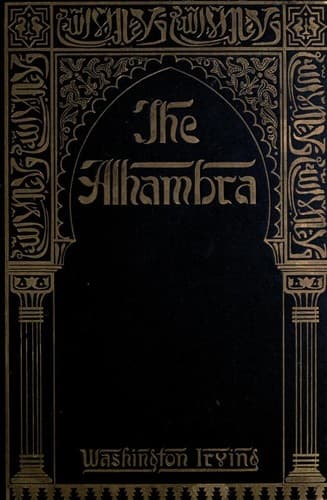
Verhalen over het gebouwencomplex in Granada, dat eigendom was van de laatste islamitische vorsten in Spanje.
Of this motley community, I find the family of my gossiping squire,
Mateo Ximenes, to form, from their numbers at least, a very important
part. His boast of being a son of the Alhambra is not unfounded. His
family has inhabited the fortress ever since the time of the Conquest,
handing down an hereditary poverty from father to son; not one of them
having ever been known to be worth a maravedi. His father, by trade a
ribbon-weaver, and who succeeded the historical tailor as the head of
the family, is now near seventy years of age, and lives in a hovel of
reeds and plaster, built by his own hands, just above the iron gate. The
furniture consists of a crazy bed, a table, and two or three chairs; a
wooden chest, containing, besides his scanty clothing, the “archives of
the family.” These are nothing more nor less than the papers of various
law-suits sustained by different generations; by which it would seem
that, with all their apparent carelessness and good-humor, they are a
litigious brood. Most of the suits have been brought against gossiping
neighbors for questioning the purity of their blood, and denying their
being _Christianos viejos_, _i.e._ old Christians, without Jewish or
Moorish taint. In fact, I doubt whether this jealousy about their blood
has not kept them so poor in purse: spending all their earnings on
escribanos and alguazils. The pride of the hovel is an escutcheon
suspended against the wall, in which are emblazoned quarterings of the
arms of the Marquis of Caiesedo, and of various other noble houses, with
which this poverty-stricken brood claim affinity.
As to Mateo himself, who is now about thirty-five years of age, he has
done his utmost to perpetuate his line and continue the poverty of the
family, having a wife and a numerous progeny, who inhabit an almost
dismantled hovel in the hamlet. How they manage to subsist, he only who
sees into all mysteries can tell; the subsistence of a Spanish family of
the kind is always a riddle to me; yet they do subsist, and what is
more, appear to enjoy their existence. The wife takes her holiday stroll
on the Paseo of Granada, with a child in her arms and half a dozen at
her heels; and the eldest daughter, now verging into womanhood, dresses
her hair with flowers, and dances gayly to the castanets.
There are two classes of people to whom life seems one long
holiday,--the very rich and the very poor; one, because they need do
nothing; the other, because they have nothing to do; but there are none
who understand the art of doing nothing and living upon nothing, better
than the poor classes of Spain. Climate does one half, and temperament
the rest. Give a Spaniard the shade in summer and the sun in winter, a
little bread, garlic, oil, and garbances, an old brown cloak and a
guitar, and let the world roll on as it pleases. Talk of poverty! with
him it has no disgrace. It sits upon him with a grandiose style, like
his ragged cloak. He is a hidalgo, even when in rags.
Public-domain text, read in full here on John Shaqi.
Reviews
Reviews
No reviews yet
Be the first to share your thoughts on this work.
Join the Discussion
Join the discussion
Sign in to leave a comment or review.
Sign InorCreate an account