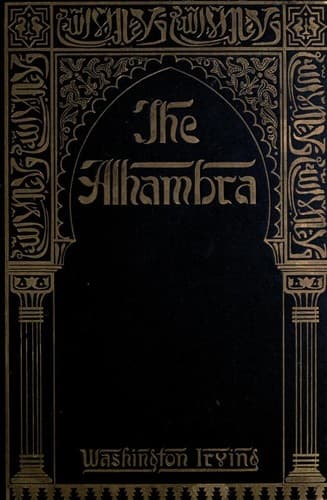
Verhalen over het gebouwencomplex in Granada, dat eigendom was van de laatste islamitische vorsten in Spanje.
guiding myself by the wall until I came to a small door at the bottom,
throwing which open, I was suddenly dazzled by emerging into the
brilliant antechamber of the Hall of Ambassadors; with the fountain of
the Court of the Alberca sparkling before me. The antechamber is
separated from the court by an elegant gallery, supported by slender
columns with spandrels of open work in the Morisco style. At each end of
the antechamber are alcoves, and its ceiling is richly stuccoed and
painted. Passing through a magnificent portal, I found myself in the
far-famed Hall of Ambassadors, the audience chamber of the Moslem
monarchs. It is said to be thirty-seven feet square, and sixty feet
high; occupies the whole interior of the Tower of Comares; and still
bears the traces of past magnificence. The walls are beautifully
stuccoed and decorated with Morisco fancifulness; the lofty ceiling was
originally of the same favorite material, with the usual frostwork and
pensile ornaments or stalactites; which, with the embellishments of
vivid coloring and gilding, must have been gorgeous in the extreme.
Unfortunately it gave way during an earthquake, and brought down with it
an immense arch which traversed the hall. It was replaced by the present
vault or dome of larch or cedar, with intersecting ribs, the whole
curiously wrought and richly colored; still Oriental in its character,
reminding one of “those ceilings of cedar and vermilion that we read of
in the Prophets and the Arabian Nights.”[4]
From the great height of the vault above the windows, the upper part of
the hall is almost lost in obscurity; yet there is a magnificence as
well as solemnity in the gloom, as through it we have gleams of rich
gilding and the brilliant tints of the Moorish pencil.
The royal throne was placed opposite the entrance in a recess, which
still bears an inscription intimating that Yusef I. (the monarch who
completed the Alhambra) made this the throne of his empire. Everything
in this noble hall seems to have been calculated to surround the throne
with impressive dignity and splendor; there was none of the elegant
voluptuousness which reigns in other parts of the palace. The tower is
of massive strength, domineering over the whole edifice and overhanging
the steep hill-side. On three sides of the Hall of Ambassadors are
windows cut through the immense thickness of the walls, and commanding
extensive prospects. The balcony of the central window especially looks
down upon the verdant valley of the Darro, with its walks, its groves,
and gardens. To the left it enjoys a distant prospect of the Vega; while
directly in front rises the rival height of the Albaycin, with its
medley of streets, and terraces, and gardens, and once crowned by a
fortress that vied in power with the Alhambra. “Ill fated the man who
lost all this!” exclaimed Charles V., as he looked forth from this
window upon the enchanting scenery it commands.
Public-domain text, read in full here on John Shaqi.
Reviews
Reviews
No reviews yet
Be the first to share your thoughts on this work.
Join the Discussion
Join the discussion
Sign in to leave a comment or review.
Sign InorCreate an account