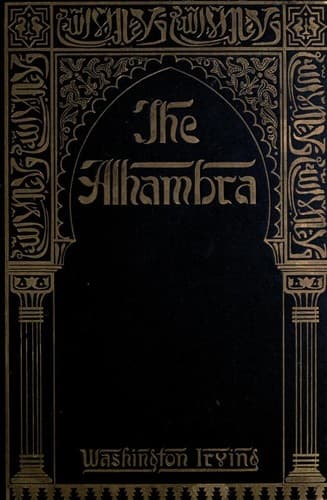
Verhalen over het gebouwencomplex in Granada, dat eigendom was van de laatste islamitische vorsten in Spanje.
Thus equipped and attended, we cantered out of “Fair Seville city” at
half-past six in the morning of a bright May day, in company with a lady
and gentleman of our acquaintance, who rode a few miles with us, in the
Spanish mode of taking leave. Our route lay through old Alcala de
Guadaira (Alcala on the river Aira), the benefactress of Seville, that
supplies it with bread and water. Here live the bakers who furnish
Seville with that delicious bread for which it is renowned; here are
fabricated those roscas well known by the well-merited appellation of
_pan de Dios_ (bread of God); with which, by the way, we ordered our
man, Sancho, to stock his alforjas for the journey. Well has this
beneficent little city been denominated the “Oven of Seville”; well has
it been called Alcala de los Panaderos (Alcala of the bakers), for a
great part of its inhabitants are of that handicraft, and the highway
hence to Seville is constantly traversed by lines of mules and donkeys
laden with great panniers of loaves and roscas.
I have said Alcala supplies Seville with water. Here are great tanks or
reservoirs, of Roman and Moorish construction, whence water is conveyed
to Seville by noble aqueducts. The springs of Alcala are almost as much
vaunted as its ovens; and to the lightness, sweetness, and purity of its
water is attributed in some measure the delicacy of its bread.
Here we halted for a time, at the ruins of the old Moorish castle, a
favorite resort for picnic parties from Seville, where we had passed
many a pleasant hour. The walls are of great extent, pierced with
loopholes; enclosing a huge square tower or keep, with the remains of
masmoras, or subterranean granaries. The Guadaira winds its stream round
the hill, at the foot of these ruins, whimpering among reeds, rushes,
and pond-lilies, and overhung with rhododendron, eglantine, yellow
myrtle, and a profusion of wild flowers and aromatic shrubs; while along
its banks are groves of oranges, citrons, and pomegranates, among which
we heard the early note of the nightingale.
A picturesque bridge was thrown across the little river, at one end of
which was the ancient Moorish mill of the castle, defended by a tower of
yellow stone; a fisherman’s net hung against the wall to dry, and hard
by in the river was his boat; a group of peasant women in bright-colored
dresses, crossing the arched bridge, were reflected in the placid
stream. Altogether it was an admirable scene for a landscape-painter.
The old Moorish mills, so often found on secluded streams, are
characteristic objects in Spanish landscape, and suggestive of the
perilous times of old. They are of stone, and often in the form of
towers with loopholes and battlements, capable of defence in those
warlike days when the country on both sides of the border was subject to
sudden inroad and hasty ravage, and when men had to labor with their
weapons at hand, and some place of temporary refuge.
Public-domain text, read in full here on John Shaqi.
Reviews
Reviews
No reviews yet
Be the first to share your thoughts on this work.
Join the Discussion
Join the discussion
Sign in to leave a comment or review.
Sign InorCreate an account