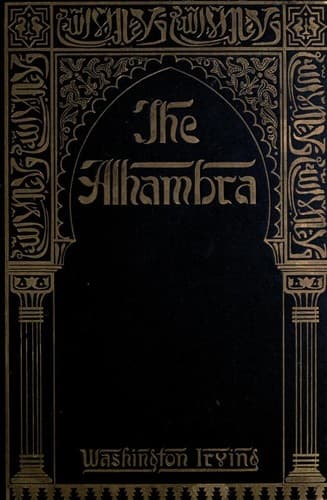
Verhalen over het gebouwencomplex in Granada, dat eigendom was van de laatste islamitische vorsten in Spanje.
Our next halting-place was at Gandul, where were the remains of another
Moorish castle, with its ruined tower, a nestling-place for storks, and
commanding a view over a vast campiña or fertile plain, with the
mountains of Ronda in the distance. These castles were strongholds to
protect the plains from the talas or forays to which they were subject,
when the fields of corn would be laid waste, the flocks and herds swept
from the vast pastures, and, together with captive peasantry, hurried
off in long cavalgadas across the borders.
At Gandul we found a tolerable posada; the good folks could not tell us
what time of day it was, the clock only struck once in the day, two
hours after noon; until that time it was guesswork. We guessed it was
full time to eat; so, alighting, we ordered a repast. While that was in
preparation, we visited the palace once the residence of the Marquis of
Gandul. All was gone to decay; there were but two or three rooms
habitable, and very poorly furnished. Yet here were the remains of
grandeur: a terrace, where fair dames and gentle cavaliers may once have
walked; a fish-pond and ruined garden, with grape-vines and date-bearing
palm-trees. Here we were joined by a fat curate, who gathered a bouquet
of roses, and presented it, very gallantly, to the lady who accompanied
us.
Below the palace was the mill, with orange-trees and aloes in front, and
a pretty stream of pure water. We took a seat in the shade; and the
millers, all leaving their work, sat down and smoked with us; for the
Andalusians are always ready for a gossip. They were waiting for the
regular visit of the barber, who came once a week to put all their chins
in order. He arrived shortly afterwards: a lad of seventeen, mounted on
a donkey, eager to display his new alforjas or saddle-bags, just bought
at a fair; price one dollar, to be paid on St. John’s day (in June), by
which time he trusted to have mown beards enough to put him in funds.
By the time the laconic clock of the castle had struck two we had
finished our dinner. So, taking leave of our Seville friends, and
leaving the millers still under the hands of the barber, we set off on
our ride across the campiña. It was one of those vast plains, common in
Spain, where for miles and miles there is neither house nor tree.
Unlucky the traveller who has to traverse it, exposed as we were to
heavy and repeated showers of rain. There is no escape nor shelter. Our
only protection was our Spanish cloaks, which nearly covered man and
horse, but grew heavier every mile. By the time we had lived through one
shower we would see another slowly but inevitably approaching;
fortunately in the interval there would be an outbreak of bright, warm,
Andalusian sunshine, which would make our cloaks send up wreaths of
steam, but which partially dried them before the next drenching.
Public-domain text, read in full here on John Shaqi.
Reviews
Reviews
No reviews yet
Be the first to share your thoughts on this work.
Join the Discussion
Join the discussion
Sign in to leave a comment or review.
Sign InorCreate an account