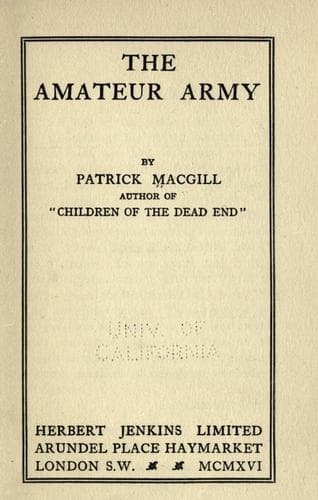
Great Britain. Army -- Military life; World War, 1914-1918 -- Personal narratives, English
At the ten minutes' halt which succeeded the first hour's march,
my Jersey friend spoke to me again. "Aren't there stars!" he said,
turning his face to the heavens and gripping his rifle tightly as if
for support. His wide open eyes seemed to have grown in size, and were
full of an expression I had never seen in them before. "I like the
stars," he remarked, "they're so wonderful. And to think that men are
killing each other now, this very minute!" He clanked the butt of his
gun on the ground and toyed with the handle of his sword.
Hour after hour passed by; under the light of the moon the country
looked beautiful; every pond showed a brilliant face to the heavens,
light mists seemed to hover over every farmhouse and cottage; light
winds swept through the telegraph wires; only the woods looked dark,
and there the trees seemed to be hugging the darkness around them.
On our way back a sharp shower, charged with a penetrating cold, fell.
The waterproof ground-sheets were unrolled, and we tied them over our
shoulders. When the rain passed, the water falling in drops from our
equipment glittered so brightly that it put the polished swords and
brilliant rifle butt-plates to shame.
We stole into the town at midnight, when nearly all the inhabitants
were abed. With arms at the trail, we marched along, throwing off
company after company, at the streets where they billeted. The
battalion dwindled down slowly; my party came to a halt, and the order
"Dismiss!" was given, and we went to our billets. The Jersey youth
came with me to my doorstep.
"'Twas a grand march!" he remarked.
"Fine," I replied.
"I can't help looking at the stars!" he said as he moved off. "There
are a lot to-night. And to think--" He hesitated, with the words
trembling on his tongue, realising that he was going to repeat
himself. "Anyway, there's some stars," he said in a low voice. "Good
night!"
There is a peculiar glamour about all night work. The importance of
night manoeuvring was emphasised in the South African War, and we had
ample opportunities of becoming accustomed to the darkness. On one
occasion at about nine o'clock we swung out from the town with our
regimental pipe-band playing to pursue some night operations. So far
the men did not know what task had been assigned to them.
"We've got to do to-night's work as quiet as a growing mushroom,"
someone whispered to me, as we took our way off the road and lined up
in the field that, stretching out in front and flanks, lost itself in
formless mistiness under the loom of the encircling hedgerows. Here
and there in the distance trees stand up gaunt and bare, holding
out their leafless branches as if in supplication to the grey sky; a
slight whisper of wind moaned along the ground and died away in the
darkness.
Public-domain text, read in full here on John Shaqi.
Reviews
Reviews
No reviews yet
Be the first to share your thoughts on this work.
Join the Discussion
Join the discussion
Sign in to leave a comment or review.
Sign InorCreate an account