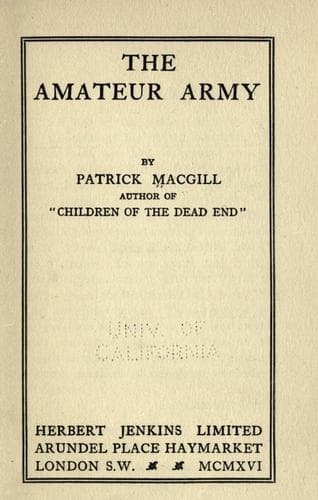
Great Britain. Army -- Military life; World War, 1914-1918 -- Personal narratives, English
Our officer, speaking in a low voice, gave instructions. "The enemy is
advancing to attack us in great force," he explained, "and our scouts
have located him some six miles away from here. We have now found that
it is inadvisable to march on any farther, as our reinforcements
are not very strong and have been delayed to rear. Therefore we have
decided to take up our present position as a suitable ground for
operations and entrenching ourselves in--ready to give battle.
Everything now must be done very quickly. Our lives will, perhaps,
depend at some early date on the quickness with which we can hide
ourselves from the foe. So; dig your trench as quickly as possible, as
quickly, in fact, as if your life depended on it. Work must be done
in absolute silence; no smoking is allowed, no lighting of matches, no
talk.
"A word about orders. Commands are not to be shouted, but will be
passed along from man to man, and none must speak above his breath.
The passing of messages along in this manner is very difficult; words
get lost, and unnecessary words are added in transit. But I hope
you'll make a success of the job. Now we'll see how quickly we can get
hidden!"
A "screen" of scouts (one man to every fifty yards of frontage) took
up its place in line a furlong ahead. A hundred paces to rear of the
"screen" the officers marked out the position of the trenches, placing
soldiers as markers on the imaginary alignment. In front lay a clear
field of fire, a deadly area for an enemy advancing to the attack.
We took off our equipment, hafted the entrenching tools which we
always carry, and bent to our work in the wet clay. The night was
close and foggy, the smell of the damp earth and the awakening spring
verdure filled our nostrils. In the distance was heard the rumbling of
trains, the jolting of wagons along the country road, the barking of
dogs, and clear and musical through all these sounds came the song of
a mavis or merle from the near hedgerows.
In the course of ten minutes we were sweating at our work, and several
units of the party took off their tunics. One hapless individual got
into trouble immediately. His shirt was not regulation colour, it was
spotlessly white and visible at a hundred yards. A whispered order
from the officer on the left faltered along the line of diggers.
"Man with white shirt, put on his tunic!"
The order was obeyed in haste, the white disappeared rapidly as the
arms of the culprit slid into sleeves, and the covering tunic hid his
wrong from the eyes of man.
Public-domain text, read in full here on John Shaqi.
Reviews
Reviews
No reviews yet
Be the first to share your thoughts on this work.
Join the Discussion
Join the discussion
Sign in to leave a comment or review.
Sign InorCreate an account