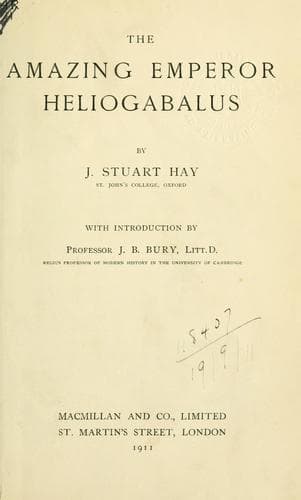
THE AMAZING EMPEROR
HELIOGABALUS
[Illustration]
MACMILLAN AND CO., LIMITED
LONDON · BOMBAY · CALCUTTA
MELBOURNE
THE MACMILLAN COMPANY
NEW YORK · BOSTON · CHICAGO
ATLANTA · SAN FRANCISCO
THE MACMILLAN CO. OF CANADA, LTD.
TORONTO
THE
AMAZING EMPEROR
HELIOGABALUS
BY
J. STUART HAY
ST. JOHN’S COLLEGE, OXFORD
WITH INTRODUCTION BY
PROFESSOR J. B. BURY, LITT.D.
REGIUS PROFESSOR OF MODERN HISTORY IN THE UNIVERSITY OF CAMBRIDGE
MACMILLAN AND CO., LIMITED
ST. MARTIN’S STREET, LONDON
1911
PREFACE
The life of the Emperor Marcus Aurelius Antoninus, generally known to the
world as Heliogabalus, is as yet shrouded in impenetrable mystery. The
picture we have of the reign is that of an imperial orgy—sacrilegious,
necromantic, and obscene. The boy Emperor, who reigned from his
fourteenth to his eighteenth year, is depicted amongst that crowd
of tyrants who held the throne of Imperial Rome, by the help of the
praetorian army, as one of the most tyrannical, certainly as the most
debased.
Few people have made any study of the documents which relate to this
particular period, and fewer still have taken the trouble to inquire
whether the accounts of the Scriptores are trustworthy or consonant with
the known facts.
To this present time no account of the life of this Emperor has been
published. Histories of the decline and fall of Imperial Rome there are
in plenty; other reigns have been examined in detail; German critics have
sifted the trustworthiness of the documents, few in number and all late
in date, which refer to other reigns; so far nothing has been done on
the life of Elagabalus.
The present writer started this study with the view that the Syrian
boy-Emperor was, in all probability, what his biographers have painted
him, and what all other writers have accepted as being a substantially
correct account of the absence of mind, will, policy, and authority
which he was supposed to have betrayed, along with other even more
reprehensible characteristics.
The first reason to doubt this estimate came from the continually
recurring mention of a perpetual struggle between the Emperor and his
female relatives; a fight in which the boy was always worsting able and
resolute women, carrying his point with consummate tact and ability,
while allowing the women a certain show of dignity and position, where it
in no way diminished the imperial authority or his own prerogative.
Public-domain text, read in full here on John Shaqi.
Reviews
Reviews
No reviews yet
Be the first to share your thoughts on this work.
Join the Discussion
Join the discussion
Sign in to leave a comment or review.
Sign InorCreate an account