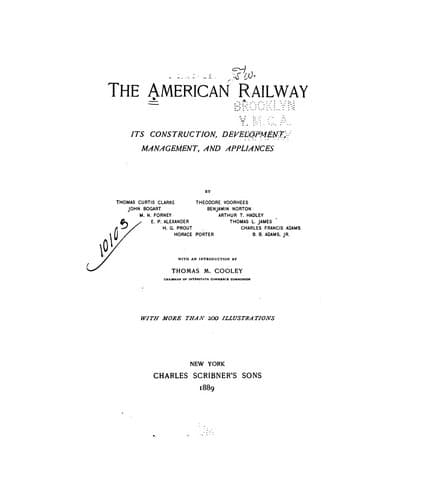
The American Railway: Its Construction, Development, Management, and AppliancesClarke, Thomas Curtis
History
The American Railway: Its Construction, Development, Management, and Appliances
Clarke, Thomas Curtis
Railroads -- United States
Formerly each railroad used its own cars exclusively, and through
freights were transferred at every junction point. This involved
such delay and expense that railroads now generally permit all
loaded cars to go through to destination without transfer, and
allow each other a certain sum for the use of cars. Usually this is
about three-quarters of a cent for each mile which the car travels
on a foreign road. This involves a great scattering of cars, and
an extensive organization to keep record of their whereabouts
and of the accounts between the companies for mileage.[15] This
organization will be referred to more fully in connection with the
department of transportation. But the joint use of each other's
cars makes it necessary that there should be at least enough
similarity in their construction and their coupling appliances to
permit their indiscriminate use upon all roads. And conventions of
master car-builders have recommended certain forms and dimensions
as standards, which are now in general use.
There is much convenience in this, but one disadvantage. It
requires almost unanimous action to introduce any change of form
or of construction, however advantageous it may be. And to secure
unanimous action in such matters is almost as hard as it would be
to secure unanimity in a change in the spelling of English words.
Still there is progress, though slow, toward several desirable
reforms, the most important of which is the adoption of a standard
automatic coupler (see p. 142).
Having shown how the property of all kinds is kept in efficient
condition, we next come to its operation. This is called
"conducting transportation," and the officer in charge is usually
called the superintendent of transportation. All train-despatchers,
conductors, train-men, and telegraph operators are under his
immediate control. He makes all schedules and provides all extra
and irregular service that the traffic department makes requisition
for, himself calling upon the superintendent of machinery for
the necessary locomotives, switching engines, and cars. It is his
especial province to handle all trains as swiftly as possible, and
to see that there are no collisions. It is impossible to detail
fully the safeguards and precautions used to this end, but the
general principles observed are as follows:
First, a general time-table or schedule is carefully made out for
all regular trains upon each division, showing on one sheet the
time of each train at each station.
Public-domain text, read in full here on John Shaqi.
Reviews
Reviews
No reviews yet
Be the first to share your thoughts on this work.
Elsewhere in the archive
Join the Discussion
Join the discussion
Sign in to leave a comment or review.
Sign InorCreate an account