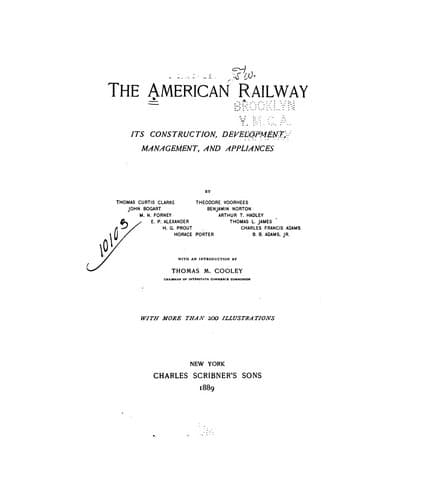
The American Railway: Its Construction, Development, Management, and AppliancesClarke, Thomas Curtis
History
The American Railway: Its Construction, Development, Management, and Appliances
Clarke, Thomas Curtis
Railroads -- United States
garnishments in certain cases, and there is much railroad and
commercial law which it behooves the officials interested to be
well posted in. When the goods arrive at destination the possession
of the bill of lading is the evidence of the consignee's right to
receive them.
Now we will return to the shipment itself and see how it is
taken care of. The whole structure of the system of collecting
freight revenue, holding accountable all agents who assess it and
collect it, dividing it in the agreed proportions between all the
railroads, boats, bridges, wharves, and transfer companies who
may handle it in its journeys, even across the continent, and
the tabulating of the immense mass of statistics which are kept
to show, separately, the quantities of freight of every possible
class and variety, by every possible route, and to and from every
possible point of destination and departure--all this system,
neither the magnitude nor the minute elaboration of which can be
adequately described within limits, is founded upon a paper called
the way-bill.
The theory of the way-bill is that no car must move without one
accompanying it, describing it by its number and the initials
of the road owning it, and showing its points of departure and
destination, its entire contents, with marks and weights of each
package, consignors and consignees, freight and charges prepaid
or to be collected at destination, and the proportion of the same
due to each carrier or transfer in the line. And not only must a
way-bill accompany the car, but a duplicate of it must be sent
immediately and directly, by the office making the original, to
the office of the auditor of freight receipts. If the railroad
is a member of any association, as the Trunk Line Association in
New York, another duplicate is sent to its office, that it may
supervise all rates, and see what each road is doing. The sum of
all the way-bills is the total of a road's freight business. To
facilitate taking copies they are printed with an ink which will
give several impressions on strong, thin tissue-paper, forming
"soft copies," while the "hard copy," or original, goes with the
freight to be checked against it when the car is unloaded.
Public-domain text, read in full here on John Shaqi.
Reviews
Reviews
No reviews yet
Be the first to share your thoughts on this work.
Elsewhere in the archive
Join the Discussion
Join the discussion
Sign in to leave a comment or review.
Sign InorCreate an account