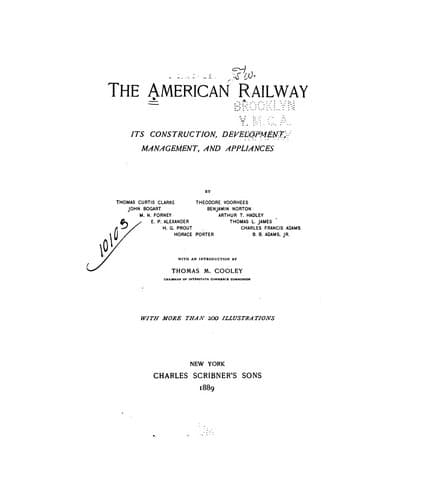
The American Railway: Its Construction, Development, Management, and AppliancesClarke, Thomas Curtis
History
The American Railway: Its Construction, Development, Management, and Appliances
Clarke, Thomas Curtis
Railroads -- United States
The railroad was a decided step in advance, compared with the
stage-coach and canal-boat, but, when we picture the surroundings
of the traveller upon railways during the first ten or fifteen
years of their existence, we find his journey was not one to
be envied. He was jammed into a narrow seat with a stiff back,
the deck of the car was low and flat, and ventilation in winter
impossible. A stove at each end did little more than generate
carbonic oxide. The passenger roasted if he sat at the end of the
car, and froze if he sat in the middle. Tallow candles furnished a
"dim religious light," but the accompanying odor did not savor of
cathedral incense. The dust was suffocating in dry weather; there
were no adequate spark-arresters on the engine, or screens at
the windows, and the begrimed passenger at the end of his journey
looked as if he had spent the day in a blacksmith-shop. Recent
experiments in obtaining a spectrum-analysis of the component parts
of a quantity of dust collected in a railway car show that minute
particles of iron form a large proportion, and under the microscope
present the appearance of a collection of tenpenny nails. As iron
administered to the human system through the respiratory organs in
the form of tenpenny nails mixed with other undesirable matter is
not especially recommended by medical practitioners, the sanitary
surroundings of the primitive railway car cannot be commended.
There were no double tracks, and no telegraph to facilitate the
safe despatching of trains. The springs of the car were hard, the
jolting intolerable, the windows rattled like those of the modern
omnibus, and conversation was a luxury that could be indulged in
only by those of recognized superiority in lung power. The brakes
were clumsy and of little service.
[Illustration: From an Old Time-table (furnished by the "A B C
Pathfinder Railway Guide").]
The ends of the flat-bar rails were cut diagonally, so that when
laid down they would lap and form a smoother joint. Occasionally
they became sprung; the spikes would not hold, and the end of the
rail with its sharp point rose high enough for the wheel to run
under it, rip it loose, and send the pointed end through the floor
of the car. This was called a "snake's head," and the unlucky being
sitting over it was likely to be impaled against the roof. So that
the traveller of that day, in addition to his other miseries, was
in momentary apprehension of being spitted like a Christmas turkey.
[Illustration: Old Boston & Worcester Railway Ticket (about 1837).]
Baggage-checks and coupon tickets were unknown. Long trips had
to be made over lines composed of a number of short independent
railways; and at the terminus of each the bedevilled passenger
had to transfer, purchase another ticket, personally pick out his
baggage, perhaps on an uncovered platform in a rain-storm, and take
his chances of securing a seat in the train in which he was to
continue his weary journey.
Public-domain text, read in full here on John Shaqi.
Reviews
Reviews
No reviews yet
Be the first to share your thoughts on this work.
Elsewhere in the archive
Join the Discussion
Join the discussion
Sign in to leave a comment or review.
Sign InorCreate an account