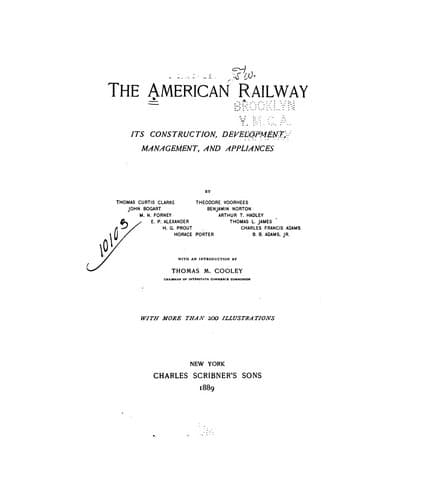
The American Railway: Its Construction, Development, Management, and AppliancesClarke, Thomas Curtis
History
The American Railway: Its Construction, Development, Management, and Appliances
Clarke, Thomas Curtis
Railroads -- United States
There is but little earnest attempt made to urge consignees to
remove freight; on the contrary, the consignees consider that
they can leave their freight as long as they choose, and that the
railroad companies are bound to hold it indefinitely.
One special practice has grown up as a result of this condition,
that of shippers sending freight to distant points to their own
order. This practice is most prolific of detention to cars, and yet
is so strongly rooted in the traffic arrangements of the country
that it is most difficult to put an end to it. Cars "to order" will
frequently stand for weeks before the contents are sold and the
consignee is discovered, during which time the cars accumulate,
stand in the way, occupy valuable space, and have to be handled
repeatedly by the transportation department of the road, all at the
direct cost of handling to the road itself, and loss of interest to
the owner of the car.
[Illustration: Floating Cars, New York Harbor.]
Only two methods have so far been suggested to abate or put an end
to the evils which have been but slightly indicated above. The
first is a change in the method of payment for car service to a
compensation based upon time as well as mileage, which is commonly
known as the "per diem plan."
This plan consists in paying for the use of all foreign cars a
fixed sum per mile run, based on the supposed cost of repairs of
the car, and a price per day based upon what is estimated to be a
fair return for the interest on its value. This plan was originally
suggested by a convention of car accountants, and was brought
up and advocated by Mr. Fink, the Chairman of the Trunk Line
Commission, in New York, in the fall of 1887. At his suggestion,
and largely through his influence, it was tried by a few of the
roads (the Trunk Lines and some of their immediate connections)
during the early part of the year 1888; the amounts as then fixed
being one-half cent per mile run, and fifteen cents per day. The
results of this experiment, while they were quite satisfactory
to the friends of the proposed change, yet were not sufficiently
conclusive to demonstrate the value of the plan to those who were
indifferent or hostile to it.
Public-domain text, read in full here on John Shaqi.
Reviews
Reviews
No reviews yet
Be the first to share your thoughts on this work.
Elsewhere in the archive
Join the Discussion
Join the discussion
Sign in to leave a comment or review.
Sign InorCreate an account