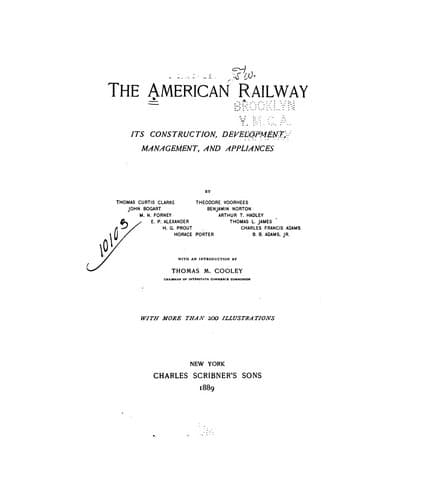
The American Railway: Its Construction, Development, Management, and AppliancesClarke, Thomas Curtis
History
The American Railway: Its Construction, Development, Management, and Appliances
Clarke, Thomas Curtis
Railroads -- United States
For various reasons, chiefly local to the roads in question, the
plan was discontinued after a few months' trial. The experiment
resulted, however, in the collection of a large mass of statistics
and other data, the study of which has led many to believe that
the plan is the proper solution of the difficulties experienced,
and, if adjusted so as not to add too much to the burden of those
railway companies who are borrowers of cars, that it would meet
with the approval of the railway companies throughout the country.
It certainly provided a strong inducement to all roads to promptly
handle foreign cars, and in that particular it proved a great
advance over the existing methods of car service. The charge per
day of fifteen cents was found too high in practice. Ten cents
per day and a half-cent per mile would produce a net sum to the
car-owner very slightly in excess of three-fourths of a cent per
mile run. While this appears but small, yet it would be quite
sufficient to amount in the aggregate to a considerable sum, and
would serve to urge all railway companies to promptly unload and
send home foreign cars. This plan would result, if generally
adopted, in largely increasing the daily movement or mileage of all
cars, or, what would be equivalent, would practically amount to a
very considerable increase in the equipment of the country.
The plan has recently been approved by the General Time Convention,
and there is strong probability that it will be very extensively
adopted and given a trial by all the railways during the year 1890.
The second method of remedying the existing evils of car service
is in a uniform and regular charge for demurrage, or car rental,
to be collected by all railroad companies with the same regularity
and uniformity that they now collect freight charges. This car
rental, or demurrage charge, would not be in any sense a revenue
to the car-owner; the idea of it being that it is a rental to the
delivering company, not only for the use of the car but for the
track on which it stands, and the inconvenience and actual cost
that the company is put to in repeated handling a car that is held
awaiting the pleasure of the consignee to unload. The difficulty
in the way of making such a charge has been the unwillingness of
any railroad company to put any obstacle in the way of the free
movement of freight to its line, and the fear that an equivalent
charge would not be made by some one of its competitors. Of late,
however, the serious disadvantages resulting from the privileges
given to consignees at competing points, by allowing them to hold
cars indefinitely, have led the different railway companies to come
together and agree upon a uniform system of demurrage charges at
certain competing points.
Public-domain text, read in full here on John Shaqi.
Reviews
Reviews
No reviews yet
Be the first to share your thoughts on this work.
Elsewhere in the archive
Join the Discussion
Join the discussion
Sign in to leave a comment or review.
Sign InorCreate an account