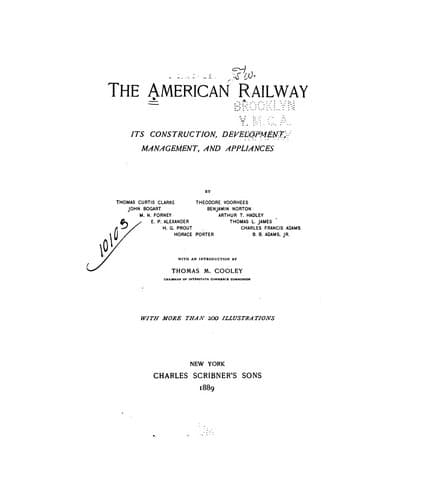
The American Railway: Its Construction, Development, Management, and AppliancesClarke, Thomas Curtis
History
The American Railway: Its Construction, Development, Management, and Appliances
Clarke, Thomas Curtis
Railroads -- United States
Exactly the same principles are involved in this matter as in the
case of a thrifty proprietor of a country-store, whose profits each
year depend materially upon the closeness and care with which his
stock in trade is purchased from the wholesale dealers in a large
city. A purchasing agent's experience is varied in the extreme,
dealing as he does with all classes of salesmen and business
houses. There is no end to the operations which skilful salesmen
go through in offering their stock; but after some experience a
sharp buyer will be able to fortify himself against the best of
them--even against the clever vender of varnishes who disposed of
one hundred barrels of his wares in small lots to different buyers,
on a sample of maple-sirup. On the other hand, a salesman who,
when a buyer asked him if his oil gummed, replied that "it gummed
beautifully," lost the chance of ever selling any goods in that
quarter.
As has been said, the ordinary or general supplies consumed in the
operation of the average railroad include almost everything known
to trade. Tobacco, for the gratification of the taste of a gang
of men out on the road with the snow-plough, is not outside the
list; and even pianos, for some trains (since the days of absolute
comfort and possible extravagance have begun) for the benefit of
passengers setting out on long journeys; nor do we lose sight of
books, bath-tubs, and barbers. The practical feature involved,
however, calls for an endless variety of expensive as well as
inexpensive materials.
It is a safe rule to follow that anything which goes into the
construction either of track, equipment, or buildings, should be
the best. Care should always be exercised against the use of any
material the failure of which might be the cause of loss of life,
and consequently result in heavy damages to the company. Iron alone
enters so extensively into railroad construction and operation
that it is safe to say three-fourths of all manufactured in this
country is consumed directly or indirectly in this way; and besides
its use in rails and fastenings (the latter including spikes,
fish-plates, and bolts and nuts), and in the many thousand tons of
car-wheels and axles annually required, there must be reckoned the
almost unlimited number of castings daily required in the way of
brake-shoes, pedestals, draw-heads, grate-bars, etc. The lumber and
timber for buildings, bridges, platforms, and crossings, and the
large quantity of glass which is necessary, are among other large
items of expenditure.
Public-domain text, read in full here on John Shaqi.
Reviews
Reviews
No reviews yet
Be the first to share your thoughts on this work.
Elsewhere in the archive
Join the Discussion
Join the discussion
Sign in to leave a comment or review.
Sign InorCreate an account