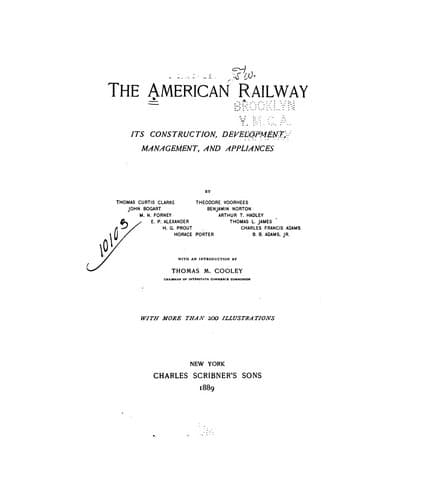
The American Railway: Its Construction, Development, Management, and AppliancesClarke, Thomas Curtis
History
The American Railway: Its Construction, Development, Management, and Appliances
Clarke, Thomas Curtis
Railroads -- United States
Directly after the inauguration of General Washington, in April,
1789, the organization of the Post-Office Department followed, and
Samuel Osgood, of Massachusetts, was appointed Postmaster-General.
That the people might derive the greatest possible advantage from
an institution peculiarly their own, this gigantic monopoly--for it
is nothing else--was created, and all competition forbidden. The
Postmaster-General had then but one clerk, and there were but 75
post-offices and 1,875 miles of post-roads in the United States;
the cost of mail transportation being $22,081, the total revenue,
$37,935, the total expenditures, $32,140; leaving a surplus of
$5,795. From this time until 1836 the contracts made for the
transportation of the mails do not mention any kind of service
on post-roads except stages, sulkies, four-horse post-coaches,
horseback, packets, and steam-boats.
[Illustration: The Pony Express--The Relay.]
The growth of the Railway Mail Service has been coincident with
that of the railway itself, and the importance of both cannot
be underestimated in considering the future development of the
country. Almost as soon as a railroad is fully organized it becomes
a mail contractor with the Department.
The Act of Congress constituting every railroad in the United
States a post-route was approved July 7, 1838. Postmaster-General
Barry, in his annual report for 1836, speaks of the multiplication
of railroads in many parts of the country, and suggests it as a
subject worthy of inquiry, whether measures may not be taken to
secure the transportation of the mail on them, and adds: "Already
have the railroads between Frenchtown, in Maryland, and Newcastle,
in Delaware, and between Camden and South Amboy, in New Jersey,
afforded great and important facilities to the transmission of the
great eastern mail." At this time a railroad between Washington and
New York was in process of construction, and Postmaster-General
Barry dwelt in his report on the importance of the facilities
that would be afforded for speedy service between the two cities,
predicting that the run between them would probably be made in
sixteen hours. The service is now performed in about five hours.
[Illustration: The Overland Mail Coach--A Star Route.]
Public-domain text, read in full here on John Shaqi.
Reviews
Reviews
No reviews yet
Be the first to share your thoughts on this work.
Elsewhere in the archive
Join the Discussion
Join the discussion
Sign in to leave a comment or review.
Sign InorCreate an account