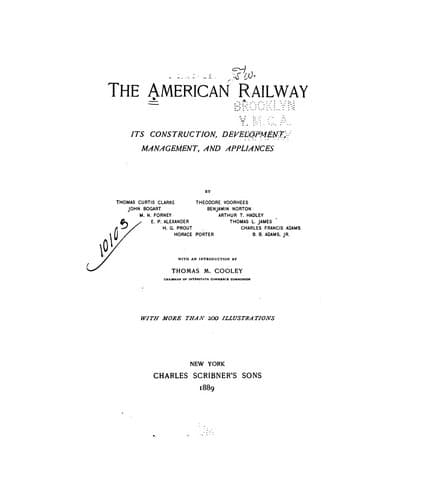
The American Railway: Its Construction, Development, Management, and AppliancesClarke, Thomas Curtis
History
The American Railway: Its Construction, Development, Management, and Appliances
Clarke, Thomas Curtis
Railroads -- United States
At first the facilities for mail services were very limited.
Postmaster-General Kendall, in 1835, suggested that the Baltimore
& Ohio Railroad Company might be asked to close in some portion of
their baggage-cars, a strong lock being placed on the apartment, to
which only the postmasters at Washington and Baltimore should have
keys. In the same report he adds: "If wheels can be constructed
which can be used alike upon the railroads and the streets of the
cities respectively, the Department will furnish an entire car
containing the mail to be delivered at one depot, and received at
the other, asking nothing of the company but to haul it." It was
even proposed at this time that the Government should have its own
locomotives, everything else on the road giving the right of way
to the mail train. This proposition was not adopted. The fear was
expressed, however, that if the Department did not have absolute
control over the road, the people would have to depend on stage
or other horse transportation for mail service. All these early
troubles in time passed away, and, through concessions on both
sides, the railways soon became the most important agent of the
Post-Office Department.
[Illustration: Mail Carrying in the Country.]
This, of course, was not accomplished without many trials and
tribulations. It seems strange, in the light of the present, to
read in an official report a remonstrance from route agents that
nearly every night dead bodies were placed in the mail crates
between Philadelphia and New York, and the mails packed around the
coffins. This breach of good order disappeared after that time, and
with it came to an end the freight methods and the old stage-coach
ideas of dealing with the mails.
A separate compartment in a baggage-car, fitted up with few
conveniences necessary for the distribution of local way-mail, was
the beginning of the system which has developed into the luxurious
postal cars of the present time. As a matter of history, however,
it is only fair to say that the system which we then adopted had
been in use for some time by our northern neighbors of Canada, who
had taken it from the mother country.
Public-domain text, read in full here on John Shaqi.
Reviews
Reviews
No reviews yet
Be the first to share your thoughts on this work.
Elsewhere in the archive
Join the Discussion
Join the discussion
Sign in to leave a comment or review.
Sign InorCreate an account