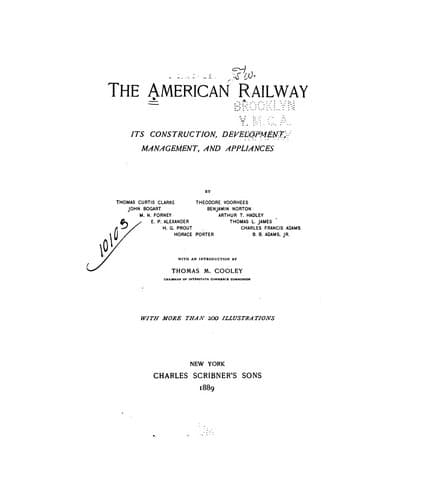
The American Railway: Its Construction, Development, Management, and AppliancesClarke, Thomas Curtis
History
The American Railway: Its Construction, Development, Management, and Appliances
Clarke, Thomas Curtis
Railroads -- United States
The credit of suggesting the first step toward the present system
has generally been given to Colonel G. B. Armstrong, who in 1864
was Assistant Postmaster at Chicago. This is incorrect; Mr. W.
A. Davis, a clerk of the St. Joseph, Mo., Post-Office, where the
overland mail was made up, conceived the idea, in 1862, that if the
letters and papers could be assorted on the cars between Quincy and
St. Joseph, the overland mail could start promptly on time. He was
given permission to carry out this idea, and there are vouchers on
file in the Department at Washington showing that he was paid for
that specific work. In 1864 Colonel Armstrong was authorized and
encouraged by the Hon. Montgomery Blair, then Postmaster-General,
to undertake the difficult task of arranging and introducing the
service. On August 31, 1864, he wrote: "To-day I commenced the new
distribution." Subsequently, Colonel Armstrong became the first
General Railway Mail Superintendent, and held this office until
ill-health compelled him to resign, in 1871. To Colonel George S.
Bangs, of Illinois, and his successors, Theodore N. Vail, William
B. Thompson, and John Jameson, is due the excellence of the present
system. Colonel Bangs was a thoroughly equipped post-office man,
energetic, courageous, and progressive. Brimful of ideas, he
was ever on the lookout for improvement. Never satisfied with
old ways, he was constantly striving to simplify and better the
service. He forgot himself in his work, and died a martyr to his
duty, leaving the Travelling Post-Office of to-day a monument to
his memory. While to Colonel Armstrong is due the credit for the
skeleton of the system, it was the genius of Colonel Bangs that
clothed the bones with flesh, developed the sinew, put the blood
in circulation, and breathed into its body the breath of life.
Colonel Bangs found, in 1871, that everything was disjointed,
disconnected, and sluggish. There was no attempt at "certainty,
security, or celerity." It was a "go-as-you-please" condition of
affairs. He grappled at once with it and brought order out of
chaos. He introduced a system of emulation among the employees,
rewarding those who displayed proficiency by promotion over the
sluggish, and thus, in fact, was probably the father of what
is now known as Civil Service Reform. In 1874 he discussed the
propriety of establishing a fast and exclusive mail train between
New York and Chicago, "this train" (quoting his report to the
Postmaster-General) "to be under the control of the Department,
so far as it is necessary for the purposes designed, and to run
the distance in about twenty-four hours. It is conceded by railway
officials that this can be done. The importance of a line like
this cannot be overestimated. It would reduce the actual time of
mail between the east and west from twelve to twenty-four hours.
As it would necessarily be established upon one or more of the
trunk lines, having an extended system of connections, its benefit
Public-domain text, read in full here on John Shaqi.
Reviews
Reviews
No reviews yet
Be the first to share your thoughts on this work.
Elsewhere in the archive
Join the Discussion
Join the discussion
Sign in to leave a comment or review.
Sign InorCreate an account