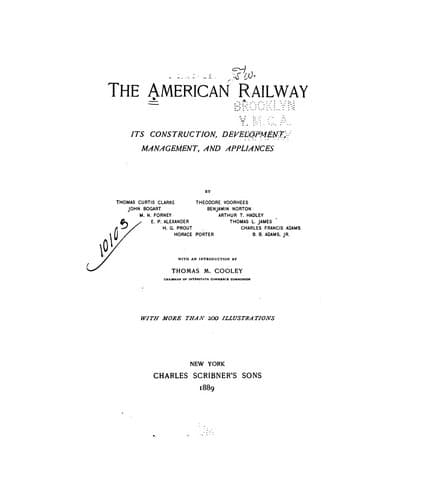
The American Railway: Its Construction, Development, Management, and AppliancesClarke, Thomas Curtis
History
The American Railway: Its Construction, Development, Management, and Appliances
Clarke, Thomas Curtis
Railroads -- United States
As befits a nineteenth century institution, the railroad dates
from 1801. In that year Benjamin Outram built in the suburbs of
London a short line of horse railroad--or tramroad, as it was
named in honor of the inventor. Other works of the same kind
followed in almost every succeeding year. They were recognized as
a decided convenience, but nothing more. It was hard to imagine
that a revolution in the world's transportation methods could
grow out of this beginning. Least of all could such a result be
foreseen in England, whose admirable canal system seemed likely
to defy competition for centuries to come. And yet, curiously
enough, it was a man wholly identified with canal business who
first foresaw the future importance of the railroad. The Duke of
Bridgewater had built canals when they were regarded as a hazardous
speculation; but they proved a success, and in the early years
of the century he was reaping a rich reward for his foresight.
One of his fellow-shareholders took occasion to congratulate the
Duke on the fact that their property was now the surest monopoly
in the land, and was startled by the reply, "I see mischief in
these--tramroads." The prophecy is all the more striking as coming
from an enemy. Like Balaam, the Duke of Bridgewater had a pecuniary
interest in cursing, but was so good a prophet that he had to tell
the truth in spite of himself, even though his curse was thereby
turned into a blessing.
It is hardly necessary to tell in detail how this prediction
was realized. Thanks to the skill and perseverance of George
Stephenson, the difficulties in the use of steam as a mode of
propulsion were rapidly overcome. What was a doubtful experiment
as late as 1815 had become an accomplished fact in 1830. The
successful working of the Liverpool & Manchester Railway gave an
impulse to similar enterprises all over the world. In 1835 there
were 1,600 miles of railroad in operation--more than half of it in
the United States. In 1845 the length of the world's railroads had
increased to more than 10,000 miles; in 1855 it was 41,000 miles;
in 1865, 90,000; in 1875, 185,000; in 1885, over 300,000.
Public-domain text, read in full here on John Shaqi.
Reviews
Reviews
No reviews yet
Be the first to share your thoughts on this work.
Elsewhere in the archive
Join the Discussion
Join the discussion
Sign in to leave a comment or review.
Sign InorCreate an account