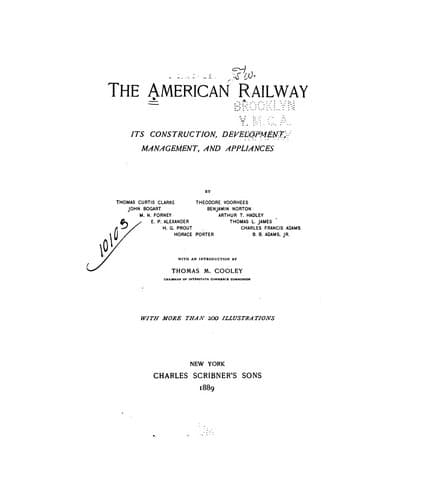
The American Railway: Its Construction, Development, Management, and AppliancesClarke, Thomas Curtis
History
The American Railway: Its Construction, Development, Management, and Appliances
Clarke, Thomas Curtis
Railroads -- United States
Of intellectual unfitness the chance is perhaps not great. The
intense competition of the modern business world makes sure that
any man, to maintain his position, must have at least some of the
qualities of mind which it exacts. But of moral unfitness the
danger is all the greater, because some of the present conditions
of business competition directly tend to foster it. A German
economist has said that the so-called survival of the fittest in
modern industry is really a double survival, side by side, of the
most talented on the one hand and the most unscrupulous on the
other. The truth of this is already apparent in railroad business.
A Vanderbilt on the Central meets a Fisk on the Erie. In spite of
his superior power and resources he is virtually beaten in the
contest--beaten, as was said at the time, because he could not
afford to go so close to the door of State's prison as his rival.
The manager of a large railroad system has under his control a
great deal of property besides his own--the property of railroad
investors which has been placed in his charge. Two lines of action
are open to him. He may make money _for_ the investors, and thereby
secure the respect of the community; or he may make money _out_ of
the investors, and thereby get rich enough to defy public opinion.
The former course has the advantage of honesty, the latter of
rapidity. It is a disgrace to the community that the latter way is
made so easy, and so readily condoned. A man has only to give to
charitable objects a little of the money obtained by violations of
trust, and a large part of the world will extol him as a public
benefactor. Nay, more; it seems as if some of our financial
operators really mistook the _vox populi_ for the _vox Dei_, and
believed that a hundred thousand dollars given to a theological
seminary meant absolution for the past and plenary indulgence for
the future. It is charged that one financier, when he undertook any
large transaction which was more than usually questionable, made a
covenant that if the Lord prospered him in his undertaking he would
divide the proceeds on favorable terms. But--as Wamba said of the
outlaws and "the fashion of their trade with Heaven"--"when they
have struck an even balance, Heaven help them with whom they next
open the account!"
Public-domain text, read in full here on John Shaqi.
Reviews
Reviews
No reviews yet
Be the first to share your thoughts on this work.
Elsewhere in the archive
Join the Discussion
Join the discussion
Sign in to leave a comment or review.
Sign InorCreate an account